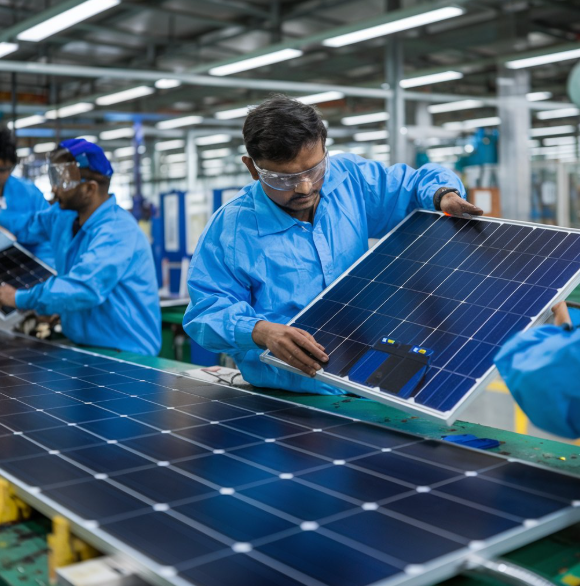
A recent report released by the Institute for Energy Economics and Financial Analysis (IEEFA) reveals that India’s Production-Linked Incentive (PLI) scheme for solar photovoltaics, launched in 2022, has significantly driven the expansion of domestic manufacturing capacity. However, challenges such as upstream supply chain delays and implementation lags continue to hinder the construction of a complete supply chain.
According to the report, as of June this year, India’s operational photovoltaic module capacity reached 120 GW, while operational cell capacity stood at 29.3 GW. Since 2022, module and cell capacities have increased by 82 GW and 22.7 GW, respectively, reflecting growth rates of 216% and 344% over three years. Vibhuti Garg, Director of South Asia at IEEFA, noted that the scheme effectively aligns government support with industrial output, fostering long-term manufacturing capacity.
In stark contrast to the robust growth in midstream and downstream sectors, upstream capacity remains severely inadequate. India’s current operational polysilicon and wafer capacities are only 3.3 GW and 5.3 GW, respectively, both driven by the PLI scheme and far from sufficient to meet the demand from midstream and downstream production. Prabhakar Sharma, Senior Consultant at JMK Research and one of the report’s authors, highlighted multiple challenges in upstream integration, including high capital intensity, insufficient incentives, fluctuating trade policies, import dependencies, and unstable raw material prices.
Policy uncertainties have further exacerbated industry difficulties. India’s import restrictions on wafers and polysilicon differ from those on cells and modules. Coupled with the constraints of the Approved List of Models and Manufacturers (ALMM) scheme for modules and its frequent revisions, domestic manufacturers face operational challenges. Additionally, reliance on imported equipment and Chinese technical expertise, compounded by visa restrictions and equipment shortages, has further delayed capacity expansion.
Delays in capacity deployment have resulted in the scheme falling short of its targets. As of June 2025, only 31 GW of the targeted 65 GW module capacity was operational, attracting approximately $5.5 billion in investments and creating 38,500 direct jobs—achieving only 58% and 20% of the respective targets.
IEEFA recommends that future PLI schemes adopt a comprehensive manufacturing-linked framework, integrating fiscal support, upfront capital subsidies, and extended policy timelines. The report calls for measures such as tax credits, low-cost financing, and tiered incentives to enhance cost competitiveness, strengthen upstream integration, and cultivate a complete domestic supply chain. Industry experts believe that addressing upstream bottlenecks and policy implementation issues will be critical for the sustainable development of India’s photovoltaic manufacturing sector.