With continuous breakthroughs in photovoltaic rear-side power generation technology, the industry’s development is undergoing a critical transition from “competition on single metrics” to “comprehensive value assessment.” The earlier judgment of Dr. Wang Le, Technical Assistant Vice President of Trina Solar, is increasingly becoming an industry consensus: “Today, with significant progress in rear-side power generation technology, the single metric of front-side module efficiency can no longer scientifically measure module performance. The sole pursuit of front-side power while neglecting other metrics will inevitably lead to a supply-demand imbalance, triggering a new round of involution.” Data shows that the global market share of bifacial modules has reached 80%, and is projected to maintain a dominant position of 86%-88% between 2025 and 2028. Bifacial power generation has become the mainstream technological path for the industry. This has also led to a re-evaluation of the value of the bifaciality rate, a core metric for PV modules—the impact of the rear-side ratio on power generation is increasing year by year, making it imperative to use total power to reflect the fundamental performance of products.
The industry’s urgent need for a scientific evaluation system is pushing testing standards closer to real-world application value. Recently, the results of the SOLARBE TEST Awards for PV Module on Specific Performance Index, jointly launched by Carbon Discovery, Solarbe, and Gsolar Test, were officially announced. In the highly anticipated category for the bifaciality rate of PV modules, Trina Solar stood out among 14 competing modules with the highest bifaciality rate of 84.74%, successfully securing the Champion of PV Module Bifaciality Rate award by helping owners fully tap into the value of reflected light resources and enhance the comprehensive revenue of power stations. This award not only serves as authoritative recognition for Trina Solar’s deep cultivation and achievements in bifacial power generation technology but also, through measured data, validates the industry value of a “total power evaluation system,” providing a practical model for overcoming the involution driven by single-metric competition.
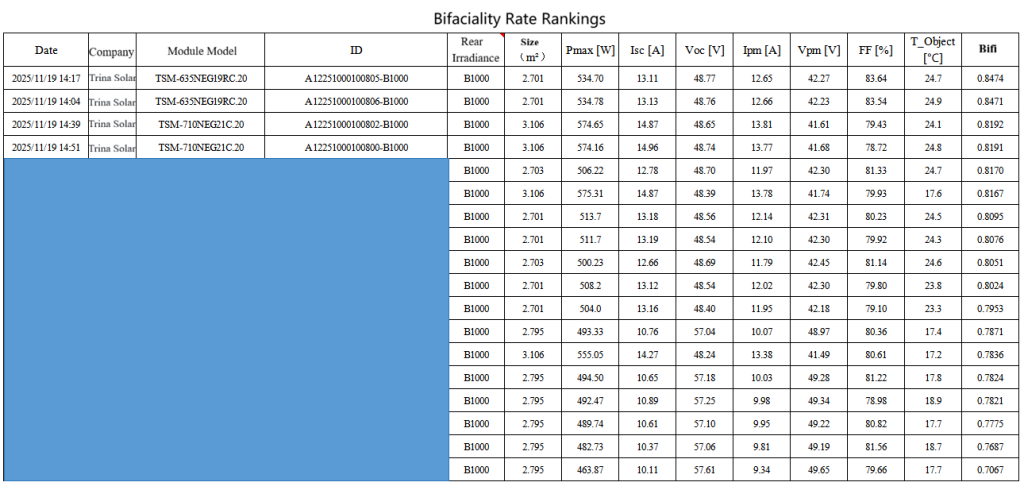
As an authoritative competition focused on real-world application scenarios, this edition of the SOLARBE TEST Awards for PV Module on Specific Performance Index designated the bifaciality rate as a core evaluation criterion. Strictly adhering to relevant international standards and specifications, the competition employed standardized testing procedures to accurately calculate the rear-side power generation gain of modules, enabling bifacial products from different companies to compete on a level playing field under unified standards. A representative from Solarbe, one of the competition’s initiators, stated that the evaluation of the bifaciality rate precisely aligns with the industry’s technological development trend. It aims to use authoritative measured data to guide the industry away from the misconception of competing solely on front-side power, and instead focus on the comprehensive power generation value of modules throughout their lifecycle, thereby providing a scientific selection basis for power investment enterprises.
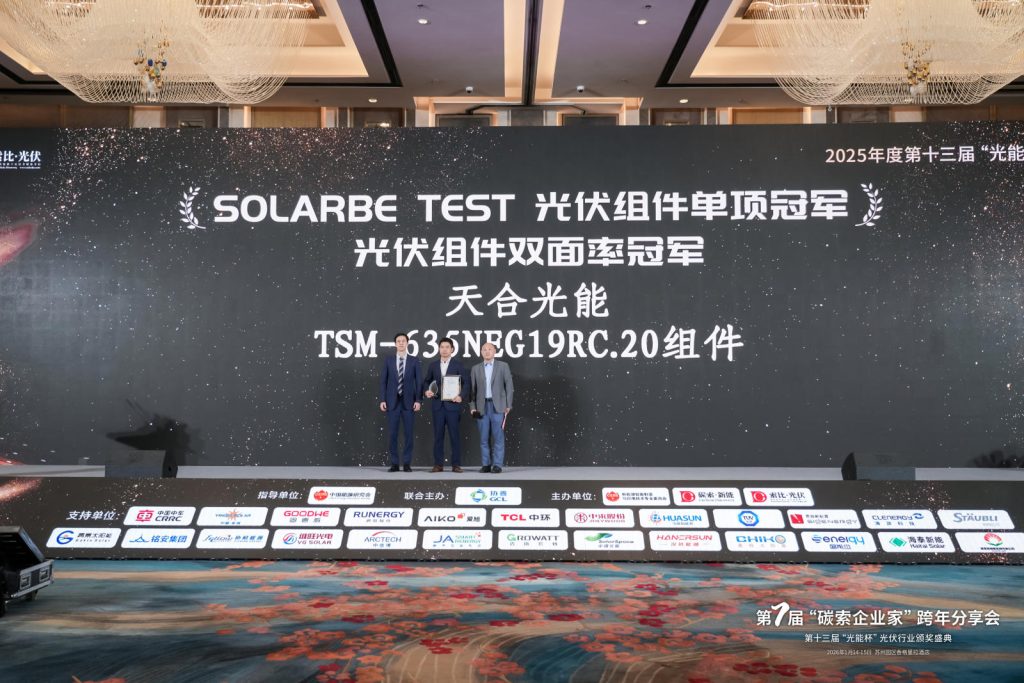
Trina Solar’s success in winning the bifaciality rate championship is attributed to its long-term deep strategic focus and continuous innovation in bifacial power generation technology. Leveraging the inherent advantages of TOPCon technology and through breakthroughs in core technologies such as light-trapping structure design and ultra-fine grid lines, Trina Solar has effectively enhanced the rear-side light absorption efficiency and energy conversion efficiency of its modules, significantly increasing the contribution of rear-side power generation. Measured data shows that the award-winning module from Trina Solar maintains stable bifacial power generation performance under various rear-side irradiance scenarios. It can fully utilize reflected light resources from ground, rooftops, etc., significantly boosting the comprehensive power generation of PV power stations, perfectly meeting the current industry demand for a total power evaluation system.
A representative from Trina Solar stated that this award represents dual recognition from the industry for the company’s technological philosophy and product strength. Trina Solar has consistently adhered to a “comprehensive value-oriented” R&D philosophy, deeply understanding the core issues behind industry involution, and persistently tackling development challenges through technological innovation. Facing the market trend where bifacial modules are becoming mainstream, the company will continue to deepen R&D in bifacial power generation technology, promoting the synergistic improvement of module bifaciality rate and comprehensive performance. Simultaneously, it will actively advocate for establishing a product evaluation system centered on total power, providing power investment enterprises with product solutions that offer greater revenue assurance.
From third-party data, with technological maturation, the bifaciality rate of modules has increased to over 80%, with some advanced products aiming for 85%. The contribution of rear-side power generation can reach up to 16.55% (in snowy conditions), becoming a key factor affecting the lifecycle power generation of PV power stations. However, traditional evaluation systems still exhibit an inertia of “emphasizing the front side while neglecting the rear side.” Some companies, in their bid to capture market share, still focus on competing on front-side power parameters, leading to intensified product homogenization and highlighting the industry’s “involutionary” development dilemma. There is an urgent need for scientific evaluation standards to guide the industry back to its value essence.
The announcement of the competition’s results injects strong momentum into the high-quality development of the photovoltaic industry. Against the backdrop of accelerating global energy transition, competition within the PV industry has shifted from a zero-sum game on single parameters to the incremental creation of comprehensive value. The “comprehensive performance measurement” concept advocated by SOLARBE TEST is poised to promote the establishment of a more scientific and holistic product evaluation system within the industry. This will guide enterprises to refocus their R&D efforts on performance optimization for real-world application scenarios, effectively curbing single-metric involution, and driving the entire PV industry towards high-quality development driven by technological innovation, thereby providing more solid support for the energy transition under the “dual-carbon” goals.