Against the backdrop of continuously optimized time-of-use (TOU) electricity pricing policies, the revenue logic for photovoltaic power plants has shifted from the sole pursuit of peak power output towards a comprehensive valuation of energy generation across all hours of the day. Notably, currently no fewer than 24 provincial-level regions in China have implemented off-peak or deep off-peak pricing during midday hours of high solar output. In some areas, the price reduction during these deep off-peak periods can be as high as 90%, drastically diminishing the revenue from noon peak generation. In stark contrast, low-irradiance periods such as early morning and dusk often coincide with standard or on-peak electricity rates in most regions, thereby re-emphasizing the value of power generation during these times. Empirical data shows that low-irradiance levels around 200 W/m² cover the daily morning and evening transition intervals as well as extended periods like cloudy or rainy days. Their cumulative contribution to a plant’s energy yield is becoming increasingly critical to its overall economics.
Recently, the results of the SOLARBE TEST Awards for PV Module on Specific Performance Index (2025), jointly launched by Carbon Discovery, Solarbe, and Gsolar Test, were officially announced. Trina Solar Co., Ltd. demonstrated exceptional low-irradiance response performance. In tests under low-irradiance conditions of 200 W/m², it achieved a Low-Irradiance Performance Ratio of 99.18% (calculated as: Power at 200 W/m² × 5 ÷ Power at 1000 W/m²), standing out among 13 competing module models to secure the award for Champion of PV Module Low-Irradiance Performance. This achievement not only serves as authoritative recognition of Trina Solar’s technical prowess but also, through empirical data, validates the core value of low-irradiance performance, providing substantial support for the industry to move beyond marketing claims and establish scientific product selection standards.
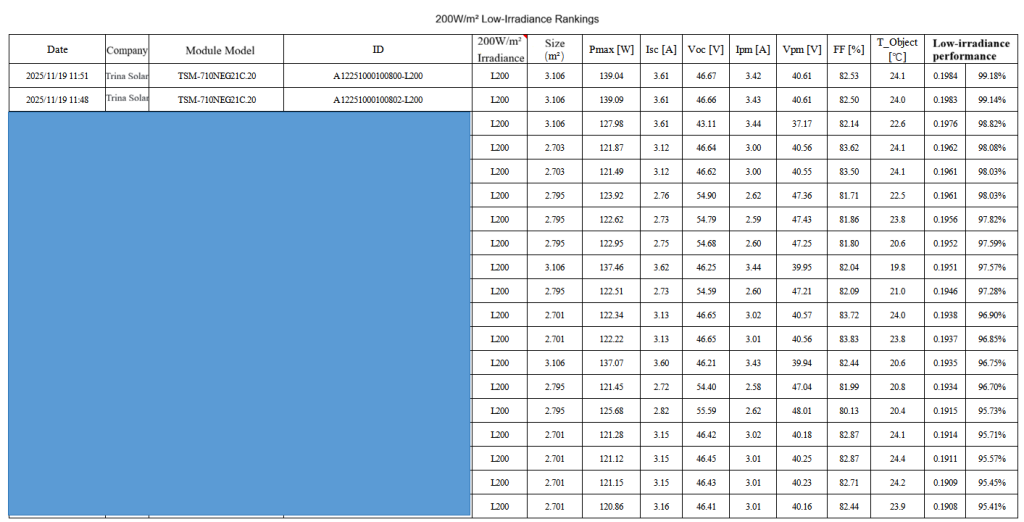
As an authoritative competition focused on real-world application scenarios, this edition of the SOLARBE TEST Awards designated the low-irradiance performance ratio as the core metric for evaluating low-light response. Through standardized testing protocols, it enabled products from different manufacturers to compete on a level playing field under identical conditions, effectively transcending the limitations of generic marketing narratives. A representative from Solarbe, one of the organizing parties, stated that this evaluation directly addresses the industry’s need for assessing performance under actual operating conditions. It aims to use empirical data to guide the industry back to the fundamental value of products, focusing on the actual power generation value for end-users. Trina Solar’s victory is attributed to its long-term, in-depth understanding of the demands in low-irradiance scenarios and its dedicated technological R&D. Leveraging the inherent advantages of TOPCon technology and through optimizations in cell structure design and passivation processes, the company has effectively reduced carrier recombination losses under low light, significantly enhancing light absorption and energy conversion efficiency. Test data confirms that Trina Solar’s modules maintain a high power output ratio relative to standard test conditions even under 200 W/m² low-irradiance environments, delivering stable performance characterized by “higher generation in mornings/evenings, and lower losses on cloudy days.” This perfectly aligns with the revenue optimization needs of power plants under current TOU pricing policies.
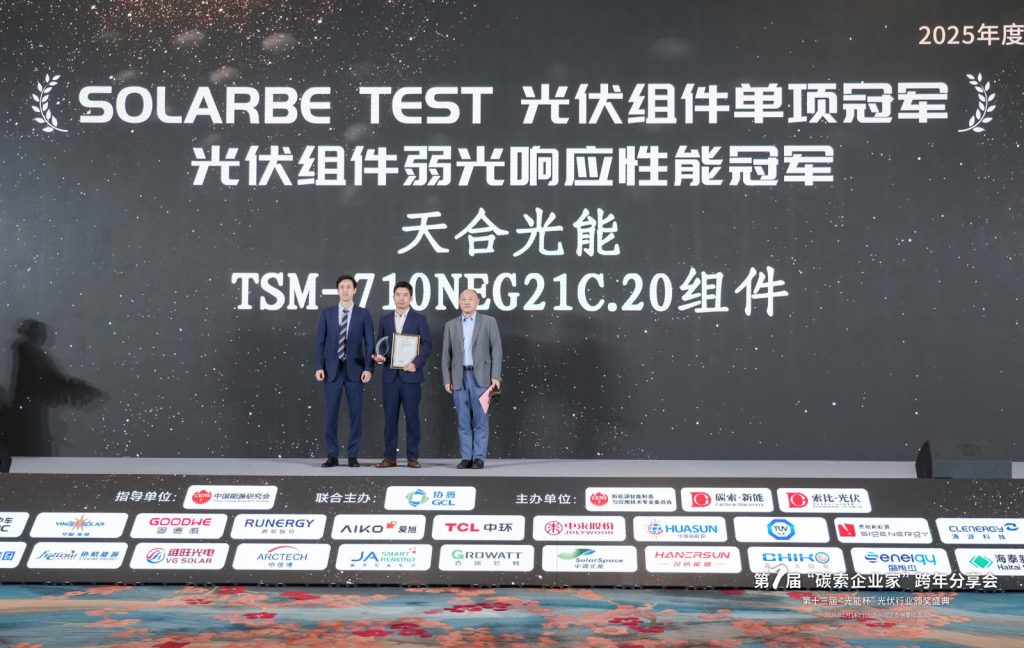
A representative from Trina Solar stated that the company has always believed the comprehensive value of a PV module should be reflected in its actual energy yield over its entire lifecycle, with low-irradiance performance being a key component. Facing the industry trend where an increasing number of provinces are implementing midday off-peak pricing, the company will continue to deepen R&D in core technologies like low-irradiance response. Building on the scaled advantages of its high-efficiency TOPCon cell technology, it aims to provide power investors with product solutions that guarantee better revenue assurance across all time periods, thereby enhancing the economic viability and competitiveness of PV projects.
Industry experts note that the core competitiveness of a PV module lies not only in its peak performance under Standard Test Conditions (STC) but also in its stable output capability under real-world operating conditions. The quality of its low-irradiance response performance directly determines a power plant’s revenue over its full lifecycle. Currently, low-irradiance performance has become a central marketing claim for PV manufacturers, each promoting their products’ superior low-light generation capability. However, vague claims are insufficient for concrete investment decisions. The industry urgently needs a set of scientific and impartial testing standards to identify truly superior technologies. The traditional evaluation system centered on nominal power under STC (1000 W/m²) fails to reflect a module’s true performance under low-irradiance (e.g., 200 W/m²) environments. This evaluation gap makes empirical verification of low-irradiance performance an industry imperative.
The announcement of the competition results provides crucial guidance for product selection in the PV industry. With the widespread implementation of TOU pricing, industry competition has evolved from a contest of peak power metrics to a comprehensive contest of generation value across all hours, making real-world performance indicators like low-irradiance response a core consideration. The “empirical verification of real performance” philosophy championed by SOLARBE TEST is poised to promote the establishment of a more scientific and holistic product evaluation system within the industry. This will guide companies to increase technological investment in complex operating conditions such as low-irradiance scenarios, thereby driving the entire PV sector toward high-quality, innovation-driven development and providing more robust support for the energy transition under the “Dual-Carbon” goals.