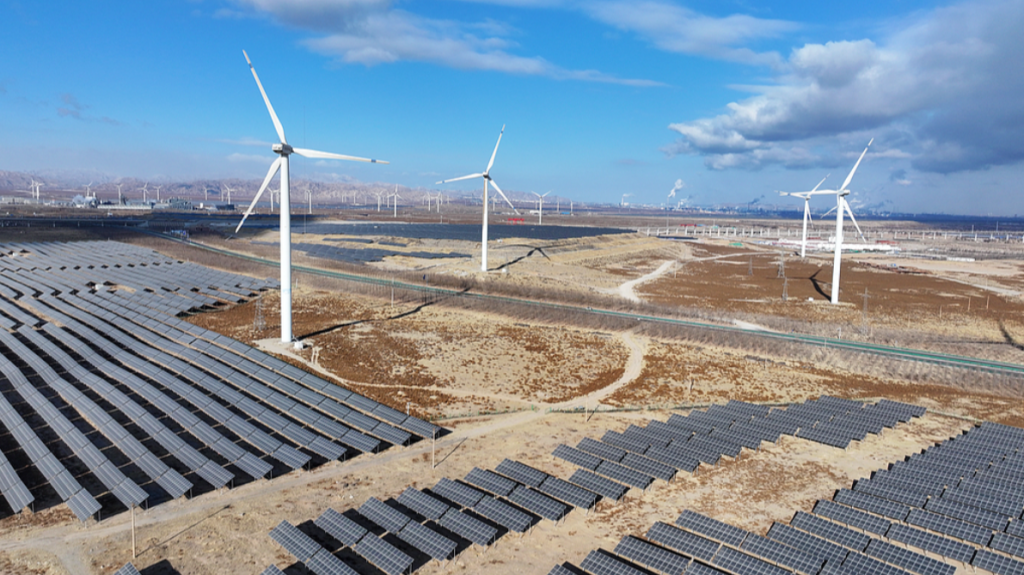
Wind turbines and photovoltaic panels at a clean energy power station in Huinong District, Shizuishan City, northwest China’s Ningxia Hui Autonomous Region, January 5, 2026. /VCG
Editor’s note: Shen Zongqing is president of Huaxia Financial Leasing Co., Ltd. Guo Bowei is an associate professor at the School of Applied Economics and director of the Center for Research on Global Energy Strategy under Renmin University of China. The article reflects the authors’ opinions and not necessarily the views of CGTN.
At this year’s World Economic Forum in Davos, climate finance, energy security and the pace of the global energy transition once again dominated discussions. Beneath the ambitious pledges, however, a more sobering reality is becoming clear: the world lacks long-term capital, system-level capability and reliable builders of clean energy infrastructure.
It is in this context that the role of Chinese companies in global clean energy should be properly understood. Their contribution goes beyond exporting products to include sustained outward investment and long-term participation in building energy systems and development capacity. Viewed this way, China’s engagement increasingly resembles the provision of a global public good.
Many leaders and policymakers in Davos expressed a similar concern: while clean energy technologies are widely available, what many countries truly need is financing, engineering expertise, grid integration capacity and long-term operational support. Across much of the developing world, binding constraints include high capital costs, weak infrastructure, limited planning capacity and fragile institutional environments.
In such circumstances, importing equipment alone does not solve the problem. What ultimately matters is whether projects can be financed at scale, built to system standards, integrated into existing grids and operated reliably over decades. Chinese companies’ overseas investment has been particularly significant in this regard. Their engagement often spans feasibility studies, system design, construction, workforce training and long-term operation – helping host countries move from isolated projects to functioning clean energy systems.
In many cases, this investment goes beyond infrastructure. Chinese companies increasingly collaborate with local partners to develop supply chains, cultivate technical skills and create employment opportunities. Local procurement, workforce localization and training programs are now integral components of overseas projects, helping build indigenous industrial capacity rather than dependence on external suppliers. By embedding projects within local economic and social contexts, these investments support not only decarbonization but also broader development goals.
From an economic perspective, the benefits of clean energy investment extend far beyond individual projects. When a country strengthens its power system through renewable deployment, the gains are widely shared: lower electricity costs, improved energy security, reduced emissions and a more attractive environment for broader economic development.
These positive spillovers cannot be fully captured by any single firm. They accrue to entire populations and often extend beyond national borders through climate benefits. This is what defines a public good. By supporting the development of green infrastructure, system capability and local capacity abroad, Chinese companies help expand the global foundations for sustainable development. For many developing economies, this is what makes clean energy efficient, affordable and scalable.
Some recent comments by U.S. President Donald Trump at Davos suggested that China manufactures wind turbines but lacks wind power at home. Such claims are inconsistent with reality. China has built the world’s largest renewable energy system and one of the most comprehensive policy frameworks for carbon reduction. Its installed wind power capacity has ranked first globally for 15 consecutive years, exceeding 600 gigawatts by late 2025. Large-scale wind farms now operate across Inner Mongolia, Xinjiang, Gansu, Hebei and coastal provinces, forming a critical component of China’s energy security.
More importantly, China’s clean energy industry did not emerge to serve export markets first. It matured through large-scale domestic deployment under complex real-world conditions. Experience in integrating renewables into vast power systems, managing intermittency, scaling storage and ensuring reliability gives Chinese companies practical credibility in overseas projects.
There is a fundamental difference between exporting equipment and investing in energy systems. Exporting solar panels or wind turbines answers the question of what technology to use. Investing in and supporting power system development addresses the more difficult question of how to build a sustainable, reliable and affordable energy future.
As the global transition enters a phase where system bottlenecks matter more than technology bottlenecks, long-term capital, engineering depth and operational capability become decisive. Chinese companies’ contribution lies not only in competitive products but also in their willingness and ability to commit capital, share risk, and help build durable infrastructure and local capacity.
More broadly, this model of outward investment offers an important lesson for global climate governance. For years, discussions on the energy transition have focused on targets, pledges and technology pathways while underestimating the political economy of implementation: who provides the capital, who bears the risks and who remains committed when conditions become uncertain.
Chinese companies increasingly represent a form of long-term engagement that bridges the gap between ambition and execution. By combining investment, engineering capacity, operational experience and local partnerships, they help transform abstract climate goals into tangible infrastructure and locally grounded development outcomes. This is not simply a commercial approach but a contribution to how large-scale transitions can realistically be delivered.
For many developing economies, such partnerships offer a practical pathway toward energy modernization without sacrificing affordability or security. China’s role is therefore not only about contributing to individual projects but also about supporting the emergence of domestic capability and fostering a more practical and inclusive model of global cooperation.
Climate change is a shared challenge. Addressing it requires practical cooperation rather than political distortion of facts. Through sustained outward investment in clean energy, Chinese companies are helping many countries reduce transition costs, strengthen energy security, create development opportunities and expand access to affordable power. The benefits extend beyond individual projects and national borders, contributing to global emissions reduction and reinforcing the foundations of sustainable development worldwide.