As bifacial power generation technology becomes mainstream in the industry, the evaluation system for the photovoltaic sector is accelerating its evolution from a focus on “single front-side metrics” towards the “comprehensive value of front-rear synergistic performance.” In the current landscape where bifacial modules are widely adopted, the traditional model of measuring product performance solely based on front-side power under standard test conditions (STC) can no longer fully reflect a module’s comprehensive power generation capability in real-world scenarios. The industry urgently needs an evaluation standard capable of precisely quantifying front-rear synergistic power generation performance. The total power measured under simultaneous front and rear side illumination stands as the core metric to overcome this evaluation dilemma, with its impact on the lifecycle energy yield and investment returns of PV power plants becoming increasingly prominent.
Recently, the results of the SOLARBE TEST Awards for PV Module on Specific Performance Index(2025), jointly launched by Carbon Discovery, Solarbe, and Gsolar Test, were officially announced. In the evaluation for the Total Power Performance of 10 PV module models, Shenzhen Skyworth Photovoltaic Technology Co., Ltd. stood out with a Total Power Coefficient of 1.1628, demonstrating exceptional technical prowess in front-rear synergistic power generation, and successfully secured the Champion of PV Module Total Power Performance award. This achievement not only serves as authoritative recognition for Skyworth Photovoltaic’s deep expertise in bifacial technology but also, through measured data, validates the industry value of a “Total Power Evaluation System,” providing a highly significant practical reference for moving beyond competition centered on single metrics.
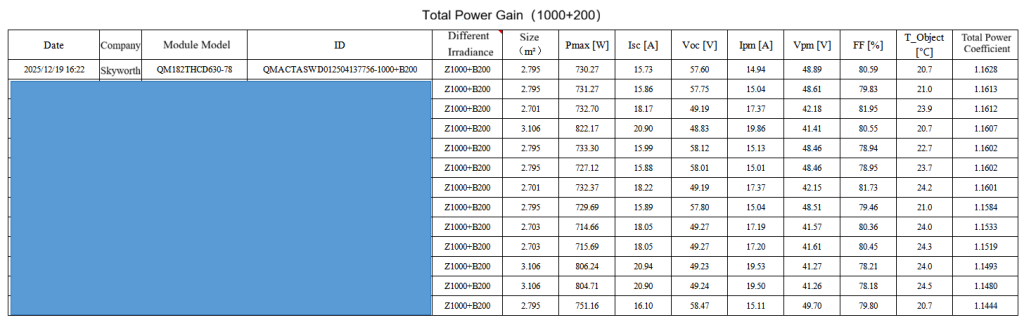
As an authoritative competition focused on real-world application scenarios, this edition of the SOLARBE TEST Awards innovatively defined the core testing methodology for total power: by calculating the ratio of a module’s power output under simultaneous illumination (1000W/m² on the front side and 200W/m² on the rear side) to its power output under single-sided illumination (1000W/m² on the front side only), it accurately quantifies the module’s front-rear synergistic power generation capability. This testing method closely aligns with real-world application scenarios—during actual power plant operation, while the front side receives direct sunlight, the rear side continuously receives irradiance from ground, rooftop, and other reflected light. Synergistic front-rear power generation is the normal operating mode for modules. A representative from Solarbe, one of the competition’s initiators, stated that the total power evaluation precisely responds to the industry’s technological development trend. By allowing products from different manufacturers to compete on a unified comprehensive performance dimension through standardized testing procedures, it aims to guide the industry away from the misconception of competing solely on front-side power. Instead, it focuses on the comprehensive power generation value of modules throughout their lifecycle, providing a more scientific selection basis for power investment enterprises.
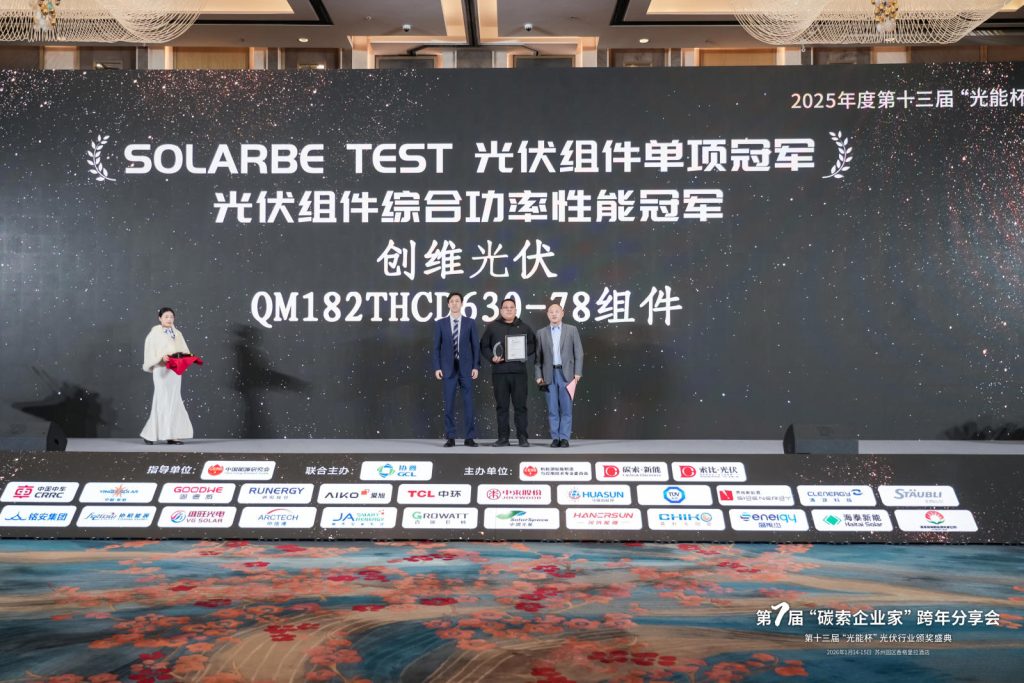
A representative from Skyworth Photovoltaic indicated that this award represents dual recognition from the industry for the company’s technological philosophy and product strength. Skyworth Photovoltaic has consistently adhered to a “comprehensive value-oriented” R&D philosophy, deeply understanding the core issues of industry involution, and persistently addressing development challenges through technological innovation. Facing the market trend where bifacial modules are becoming mainstream, the company will continue to deepen R&D in bifacial power generation technology. While enhancing front-side light absorption efficiency, it has also strengthened the rear side’s capability for secondary absorption of reflected light. Combined with an anti-soiling effect, this achieves synergistic optimization of front and rear power generation performance, enabling stable output even under complex lighting conditions. This approach fully exploits the value of light resources, promotes the coordinated improvement of module total power and lifecycle reliability, significantly increases the comprehensive energy yield of PV power stations, perfectly meets the current industry demand for a total power evaluation system, and provides power investment enterprises with product solutions offering greater revenue assurance.
Currently, the global market share of bifacial modules has exceeded 80% and is projected to stabilize within the dominant range of 86%-88% between 2025 and 2028. Bifacial power generation has become an irreversible mainstream technological path for the industry, fully justifying the necessity of total power evaluation. The industry’s urgent need for a comprehensive evaluation system is driving testing standards to align more deeply with real-world application value. As technology matures, the contribution of rear-side power generation is gradually increasing, becoming a significant incremental source for boosting power plant revenue. However, the homogenized competition model, where some companies focus solely on competing over single front-side power parameters, has not fundamentally changed. The industry’s “involutionary” development dilemma persists, urgently requiring a scientific comprehensive evaluation standard to guide the industry back to its value essence.
The announcement of the competition’s results injects strong momentum into the high-quality development of the photovoltaic industry. Against the backdrop of an accelerating global energy transition, competition within the PV industry has shifted from a zero-sum game on single parameters to the incremental creation of comprehensive value. The “Comprehensive Performance Measurement” concept advocated by SOLARBE TEST is poised to promote the establishment of a more scientific and holistic product evaluation system within the industry. This will guide enterprises to refocus their R&D efforts on optimizing front-rear synergistic performance for real-world application scenarios, effectively curb single-metric involution, drive the entire PV industry towards high-quality development fueled by technological innovation, and provide more solid support for the energy transition under the “Dual-Carbon” goals.