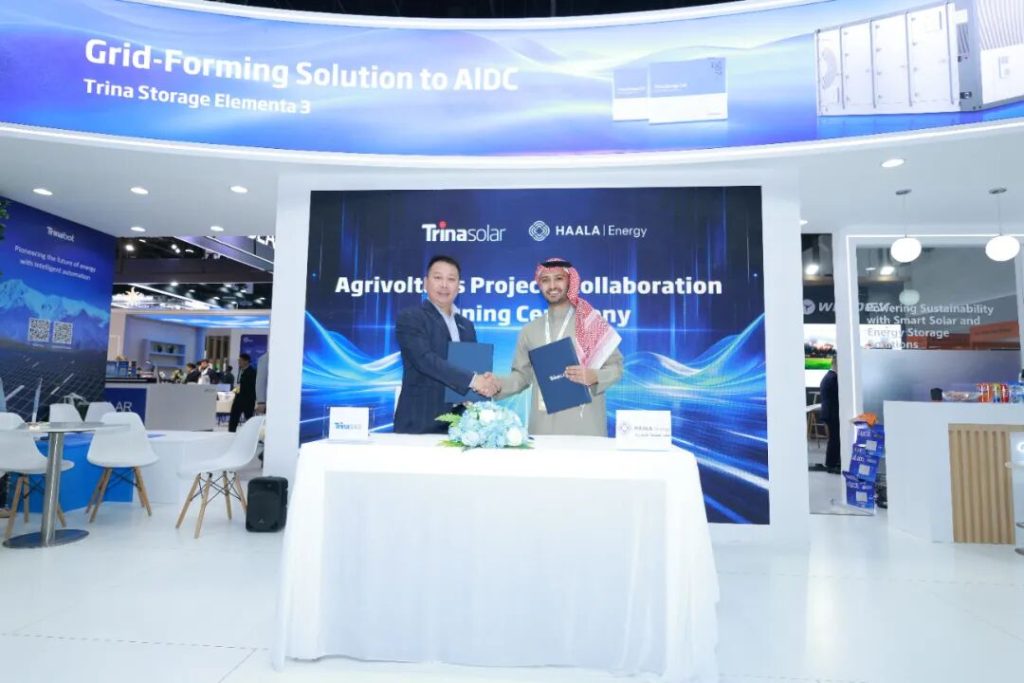
On January 14, at the World Future Energy Summit (WFES), Trina Solar signed a strategic cooperation agreement with Haala Energy, a leading photovoltaic developer and installer in Saudi Arabia. This collaboration focuses on Saudi Arabia’s unique agricultural scenarios, aiming to drive the implementation of efficient and sustainable photovoltaic solutions in the country’s agrivoltaic applications.
As one of the largest agricultural producers in the Middle East, Saudi Arabia has established a highly intensive agricultural system. Agricultural production has long-term and rigid demands for stable energy supply, water resource management, and operational efficiency. Against this backdrop, agrivoltaics, as a solution that balances power generation efficiency and comprehensive land utilization value, is becoming a crucial pathway for Saudi Arabia’s green agricultural transformation and energy structure optimization.
Among Saudi Arabia’s diverse agricultural scenarios, date palm plantations stand out as a typical application for agrivoltaics due to their large scale, concentrated land use, and high sensitivity to shading and water management. According to the agreement, Haala Energy will develop two agrivoltaic projects for farms under the renowned Saudi date brand Bateel, with a total installed capacity of approximately 1.8 MWp. The projects will utilize Trina Solar’s high-efficiency modules, intelligent tracking systems, and automated cleaning equipment. Through coordinated hardware and software design, the projects aim to enhance power generation efficiency, optimize operational and maintenance costs, and achieve efficient deployment on existing farmland while coexisting harmoniously with the agricultural production environment. The projects are expected to be connected to the grid in the first quarter of this year.
Different from traditional single-equipment supply models, this collaboration focuses on agricultural application scenarios to deliver practical, scenario-based solutions. By aligning power generation performance with agricultural operational needs, agrivoltaics can improve microclimatic conditions in farmland, contributing to the stability and sustainability of agricultural production. This also demonstrates the replicability and implementation value of such solutions in Saudi Arabia’s agricultural contexts.
Additionally, the two parties will conduct pilot research-oriented photovoltaic projects to explore the application potential of advanced photovoltaic technologies, providing technical references for the development of clean energy in Saudi Arabia.