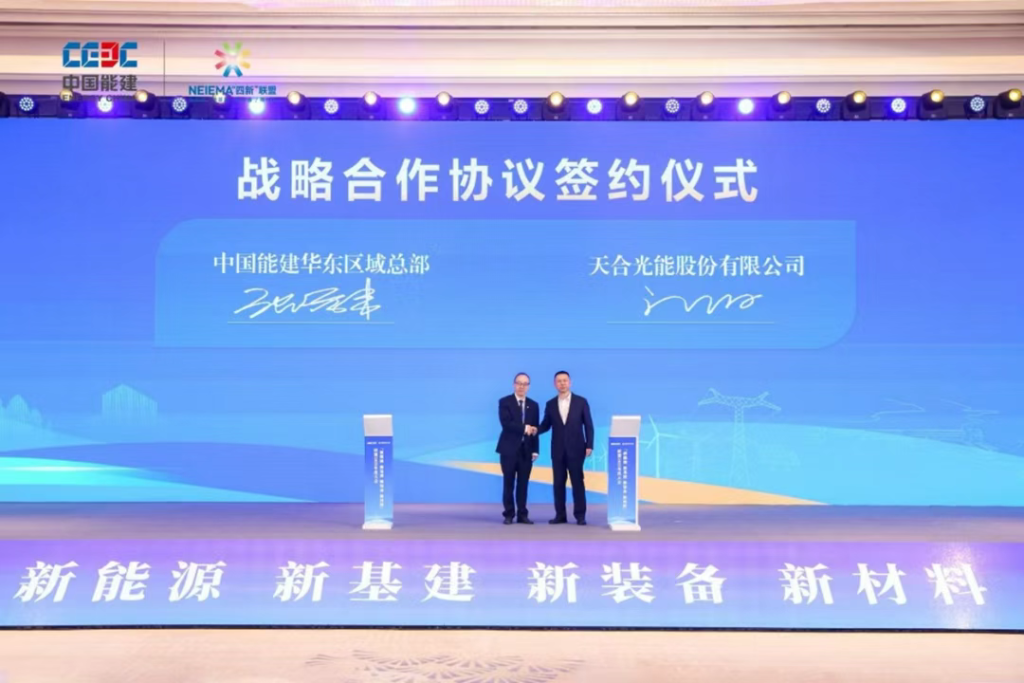
On December 11, the “New Energy, New Infrastructure, New Equipment, New Materials” Alliance 2025 Annual Conference was held in Changzhou. Trina Solar was honored as an “Outstanding Member of the 2025 Alliance.” Chairman Gao Jifan was invited to deliver a speech and signed a strategic cooperation agreement with China Energy Engineering Group. Leveraging their respective leading advantages in the photovoltaic industry and the energy and power sector, the two parties will further deepen comprehensive and multi-faceted collaboration, jointly promote the integrated development of the “Four New” industries, and contribute to building a clean, low-carbon, safe, and efficient modern energy system.
In his speech, Gao Jifan noted that Trina Solar and China Energy Engineering Group share a profound history of cooperation with remarkable achievements. Since 2021, the two sides have signed multiple strategic agreements. In 2022, they jointly initiated the establishment of the “China New Energy Storage Industry Innovation Alliance.” From 2023 to 2025, their cooperation continued to deepen, with Trina Solar joining the New Energy International Investment Alliance initiated by China Energy Engineering Group International. To date, Trina Solar has been included in China Energy Engineering Group’s centralized procurement catalog for components, energy storage, mounting systems, and hydrogen energy for multiple consecutive years. The total cooperation volume for photovoltaic modules and mounting systems has exceeded 10 GW, while the scale of energy storage project cooperation has surpassed 1 GWh, laying a solid foundation for further collaboration. Additionally, through the strategic partnership with China Energy Engineering Group, Trina Solar has established several benchmark solar-plus-storage power plant projects nationwide.
At the conference, Gao Jifan outlined three core directions for deepening cooperation between the two parties, demonstrating a firm commitment to synergistic and mutually beneficial outcomes: First, strengthen technological research and development, jointly tackling key technologies such as perovskite tandem modules, long-life and high-safety energy storage systems, and intelligent management, to create integrated solutions for new energy, new infrastructure, new equipment, and new materials. Second, deepen the construction of benchmark projects, jointly developing integrated photovoltaic benchmark projects such as offshore solar, smart microgrids, and zero-carbon parks, to validate technological value in real-world scenarios. Third, promote industrial integration by breaking down industry barriers, supporting the low-carbon energy transition in new scenarios such as green hydrogen-ammonia-methanol, green computing power, and green mining, and building a safe, efficient, open, and win-win modern energy ecosystem.