the latest briefing of the European photovoltaic association (SolarPower Europe, SPE), “Photovoltaic and Energy Storage Helps Energy Security (Solar and Storage for Energy Security)”, shows that in the first 17 days after the Middle East conflict broke out in March 2026, the EU avoided about 1.9 billion euros of natural gas power generation costs by means of photovoltaic power generation, saving 0.1117 billion euros of fossil fuel imports per day. The report points out that if natural gas is used to replace the 19.9 TWh photovoltaic power generated in the same period, the EU will have to bear an additional 32% of the import cost, highlighting the irreplaceable nature of photovoltaic in dealing with geopolitical crises and stabilizing electricity prices.
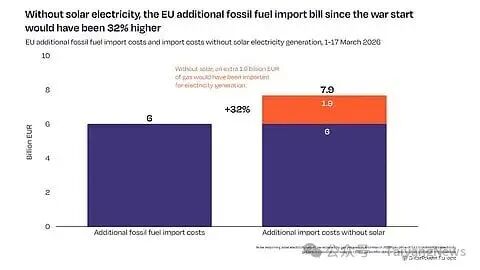
according to SPE’s calculation based on Rystad Energy’s natural gas price data, EU photovoltaic power generation reached 19.9 TWh in the first 17 days of March 2026, directly helping the region to avoid about 1.9 billion euros of natural gas power generation costs. According to statistics, since the outbreak of the war, the European Commission has spent 6 billion euros on fossil fuel imports, and the contribution of photovoltaics is equivalent to an additional burden reduction of 32% on this basis. In March alone, the total savings from photovoltaics amounted to 3.77 billion euros.
The report predicts that the total installed PV power generation in the EU will reach 415 TWh in 2026. If the price of natural gas is calculated in mid-March, replacing these photovoltaic electricity with natural gas will increase the cost of EU imports by 34.8 billion euros. SPE further warned that if the conflict in the Middle East continues to intensify and impact global supply chains, the natural gas import bill could soar to 67.5 billion euros for the rest of 2026.
The SPE quantified the long-term benefits in the briefing: “Based on gas price expectations and PV deployment trajectories in mid-March, PV power generation will avoid up to € 170 billion of natural gas import costs between 2026 and 2030 (assuming that this part of the electricity was originally generated by natural gas). This represents an average annual saving of 34 billion euros, which is enough to install 34 GW of photovoltaic systems, more than half of the EU’s annual photovoltaic installation this year.”
Despite the bright data, SPE CEO Walburga Hemetsberger pointed out: “In 2024 and 2025, due to the huge costs caused by energy dependence, the EU’s photovoltaic deployment has stalled. New data remind us that photovoltaic is serving Europe at the moment, and its scale benefits for future security and economy cannot be underestimated.” The report emphasizes that accelerating PV deployment combined with energy storage and flexibility solutions can maximize PV value and limit the impact of natural gas prices on the electricity market by shifting supply and reducing peak loads.
The report lists two typical cases to prove how enterprises can reduce energy consumption costs through “photovoltaic + energy storage. In Germany, steel producer Salzgitter (Salzgitter) signed a power purchase agreement (PPA) for an annual supply of 370 GWh in 2024, locking in a fixed electricity price. It is estimated that the company saves about 12 million euros per year compared to wholesale market prices. If the cost of natural gas pushes up electricity prices, the annual savings could increase to 26.5 million or even 49 million euros in a severe price surge scenario. Dries Acke, deputy CEO of SolarPower Europe, made it clear that battery storage, demand response and flexible grids should be “absolute priorities” for the EU “. He added: “Battery storage is the fastest and most effective means of preventing expensive gas from setting electricity prices, which in turn will make electrification and flexibility of European industries and households more economically feasible.”