As the photovoltaic industry enters a cycle of high-quality development, the traditional evaluation system centered on nominal power under standard irradiation can no longer adequately meet the end market’s demand for full lifecycle returns. In particular, with the global market share of bifacial modules surpassing 80%, coupled with the widespread adoption of time-of-use electricity pricing policies domestically, the competitive logic of the photovoltaic industry is shifting from single-parameter comparisons to full lifecycle value creation. The industry urgently requires a scientific evaluation system aligned with real-world application scenarios to steer away from homogeneous competition and return to the intrinsic value of products.
Against this backdrop, the SOLARBE TEST International PV Module Awards for Specific Performance Index, jointly organized by Carbon Discovery, Solarbe, and Gsolar Test, has officially concluded. As an authoritative competition focusing on the real-world application value of PV modules, this year’s event adhered to the principle of “validating core performance with empirical data to lead the industry toward high-quality development.” It closely aligned with the actual operating conditions of PV power stations over their 25–30-year lifespan, covering diverse real-world scenarios such as medium-to-low irradiation at 800 W/m², low irradiance at 200 W/m², and bifacial power generation. The competition aimed to guide the industry away from the pitfalls of parameter-centric comparisons. Through standardized testing procedures and a scientific evaluation system, it accurately identified high-quality products under real-world operating conditions, setting a value-oriented benchmark for the industry. A representative of the event organizer stated, “The setup of each track in this year’s competition precisely addresses the industry’s urgent need for scientific selection standards. Each award category focuses on key factors influencing end power generation revenue, aiming to use authoritative empirical data to steer the industry away from parameter-centric competition.”
After rigorous standardized testing and multi-dimensional comprehensive evaluation, the champions of each category in this year’s competition were officially announced:
● In the category for Champion of PV Module Conversion Efficiency at 800W/m² Irradiance, GCL System Integration Technology Co., Ltd. stood out with outstanding adaptability to medium-to-low irradiation conditions, achieving a measured conversion efficiency of 23.43%, providing reliable assurance for enhancing full lifecycle power generation.
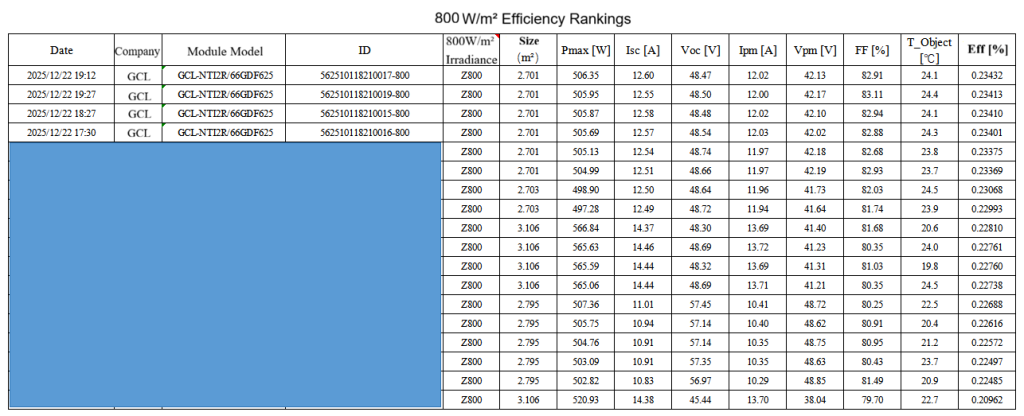
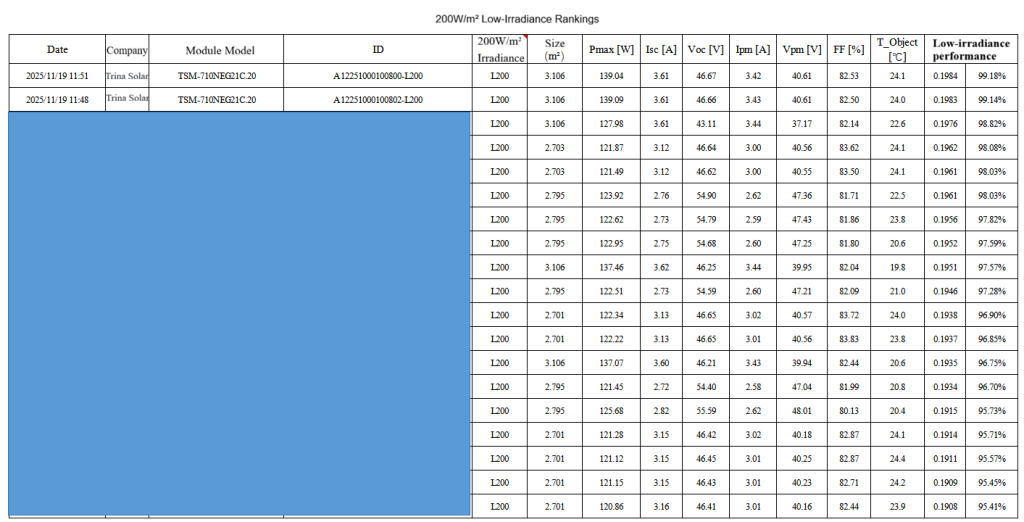
● In the category for Champion of PV Module Low-irradiance Performance, Trina Solar Co., Ltd. claimed the championship with a low-irradiance performance ratio of 99.18% (Power of module at 200W/m² × 5 ÷ Power of module at 1000W/m²). Its products’ stable output capability during low-irradiance periods such as mornings, evenings, and cloudy or rainy days perfectly aligns with the revenue optimization needs under time-of-use electricity pricing policies, making power generation during such periods more valuable.
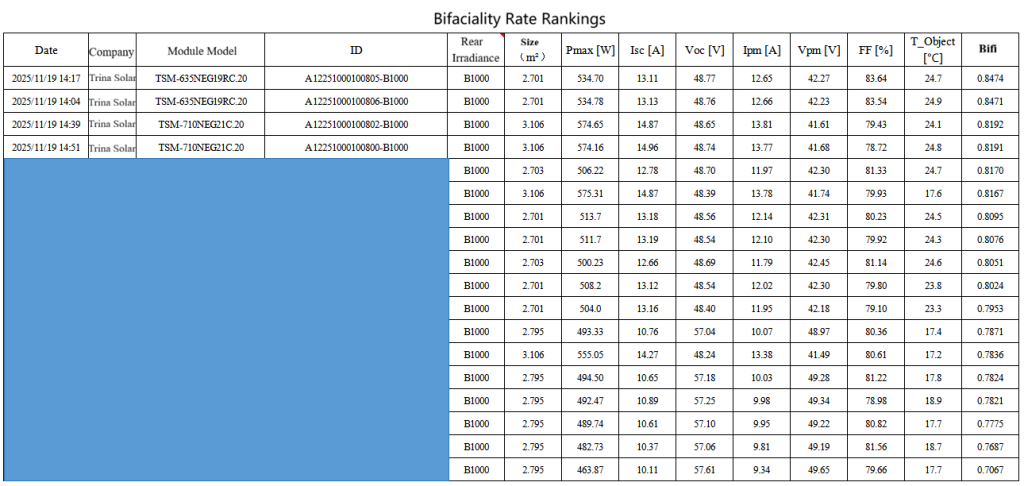
● In the category for Champion of PV Module Bifaciality Rate, Trina Solar Co., Ltd. emerged victorious again, achieving an ultra-high bifaciality rate of 84.74%, helping owners fully harness the value of reflected light resources and enhance the overall revenue of power stations.
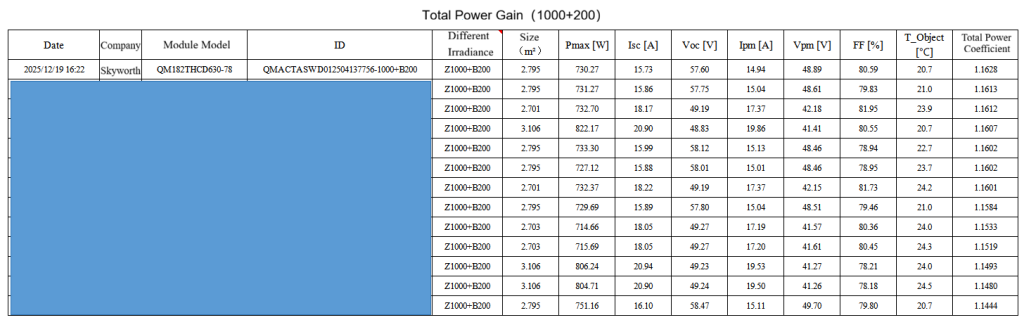
● In the category for Champion of PV Module Total Power Performance, Shenzhen Skyworth Photovoltaic Technology Co., Ltd. delivered an impressive performance. Its products achieved a total power coefficient of 1.1628 (Power of module under simultaneous illumination of 1000W/m² on front side and 200W/m² on rear side ÷ Power of module under 1000W/m² on front side), demonstrating excellent synergistic power generation capability on both sides and highlighting how comprehensive performance enhances end value.
A representative of the event organizer and head of Solarbe commented, “The successful conclusion of this year’s competition not only accomplished the precise selection of high-quality PV modules but, more importantly, advanced the industry’s evaluation philosophy. Currently, the competitive logic of the photovoltaic industry has shifted from single-parameter comparisons to full lifecycle value creation. The ‘real-world scenario validation’ concept advocated by SOLARBE TEST aims to guide enterprises to focus on end-user needs for technological innovation through a scientific evaluation system and help power investment companies establish more scientific selection criteria, thereby steering the entire industry away from homogeneous competition and achieving high-quality development.” He emphasized that, moving forward, they will continue to deepen efforts in evaluating the real-world performance of PV modules, continuously optimize the evaluation system, enrich the dimensions of testing scenarios, and build an industry service bridge connecting “technological innovation—empirical validation—market application.” This will encourage more enterprises to focus on real-world application value for technological breakthroughs, support the construction of a globally leading Chinese PV evaluation system, and provide stronger technical and industrial support for the energy transition under the “dual-carbon” goals.