In recent years, competition in the PV module industry has continued to intensify. In particular, as production capacity across all links of the industrial chain has been continuously released, companies have engaged in fierce competition in product pricing, channel expansion, and delivery capability in order to vie for limited order resources.
From the perspective of end markets, demand growth has not completely eliminated the supply-demand imbalance. Data from the National Energy Administration shows that in the first nine months of this year, China added 110 GW of new PV grid-connected capacity, including 45.8 GW of centralized PV and 64.52 GW of distributed PV. PV installations have continued to grow to a certain scale, but new installations were less than half of the level in the same period last year. As the PV installation base continues to expand, factors such as the pace of new project development, grid consumption conditions, and investment returns are increasingly affecting market demand. Weak demand is the main reason for intensified market competition.
Currently, the PV module industry is entering a new round of competitive landscape adjustment. On the one hand, leading companies continue to consolidate their market positions by leveraging advantages in brand, technology, scale, and channels, and generally achieve an overseas sales share of 50% (by volume). On the other hand, second- and third-tier companies face multiple pressures in order acquisition, capacity utilization, and profit margins, and the gap between companies has further widened. Against this backdrop, changes in module companies’ market share, bidding performance, technology route deployment, and business strategy adjustments are becoming important entry points for observing the evolution of the PV industry’s competitive landscape.
To help the industrial chain fully understand the actual state of industry development and understand the achievements and problems of the first three quarters, Solarbe.com & Carbon Discovery NERI has officially released this ranking list of module shipments in the first three quarters of 2026, covering 25 PV companies, for reference. At the same time, we once again call on PV companies to pay attention to their own profitability while boosting shipments, strive to expand overseas markets, and endeavor to achieve “sell more and earn more.”
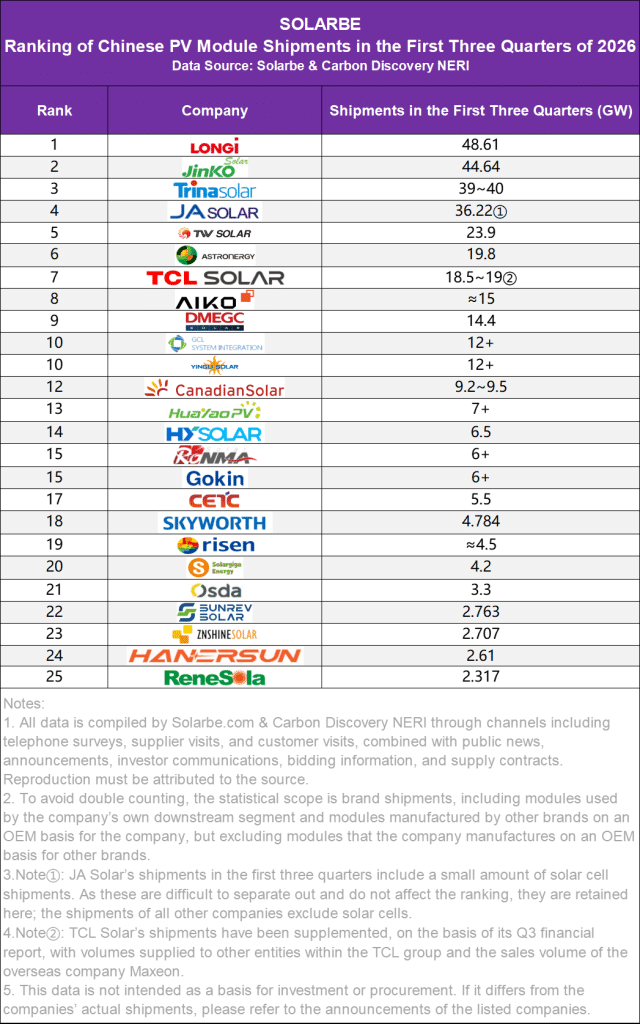
LONGi Green Energy topped the list with module shipments of 48.61 GW, of which BC module sales reached 31.64 GW, accounting for more than 65% of shipments, with significant increases in its share in overseas and distributed markets.
JinkoSolar ranked second with module shipments of 44.64 GW in the first three quarters. It is worth noting that its overseas sales share and high-efficiency module share are both at leading levels, and in the third quarter, Tiger Neo 3 modules accounted for more than one-third of its shipments.
Trina Solar ranked third with module shipments of approximately 39~40 GW in the first three quarters. It is one of the main promoters of “dividing module tender sections according to national standard tiers,” hoping to use this opportunity to enable high-efficiency TOPCon modules to also enjoy a certain premium.
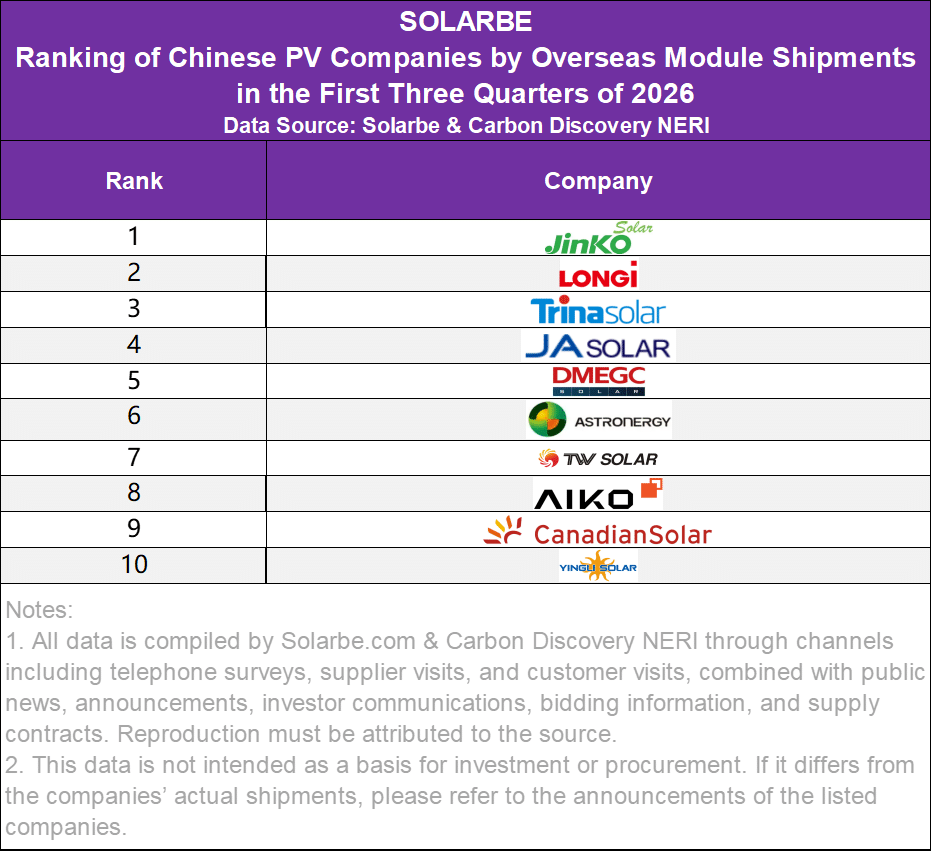
JA Solar ranked fourth with cell and module shipments of 36.22 GW in the first three quarters. The overall market share of the top four was approximately 48%. It is worth noting that JA Solar’s overseas module shipment share reached 60.92%. Clearly, it is also working hard to expand into overseas markets in pursuit of higher profits.
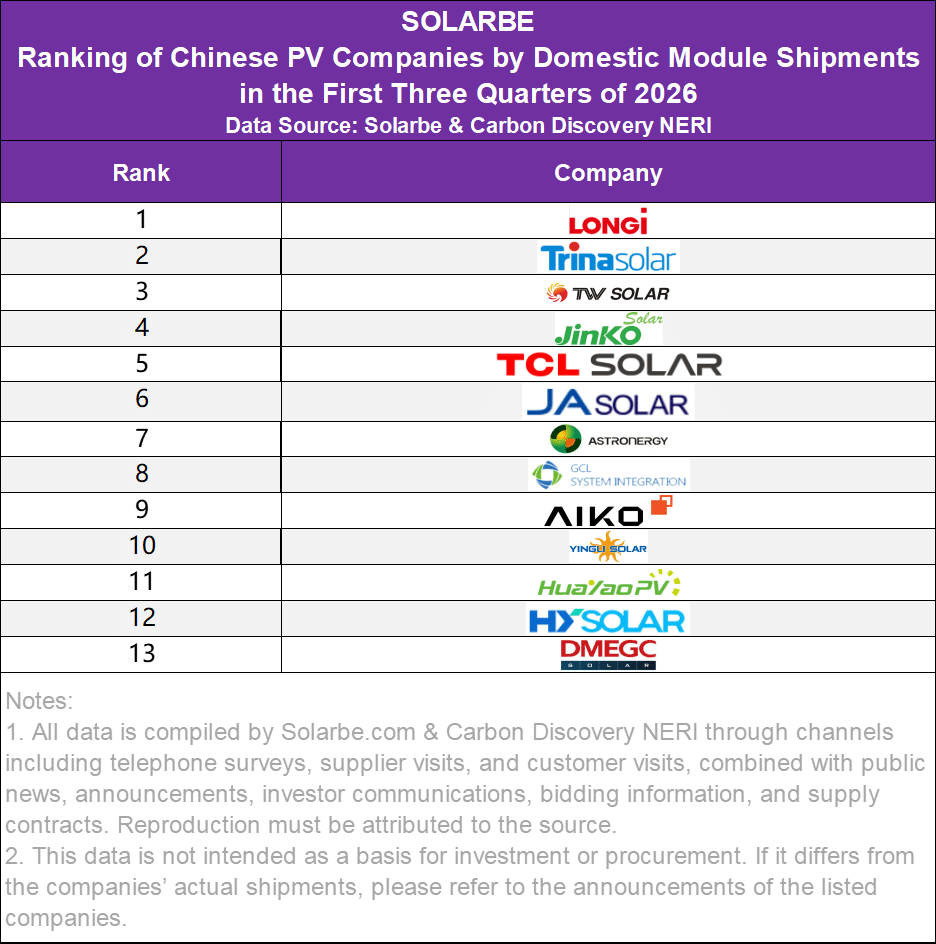
Tongwei Solar ranked fifth with module shipments of approximately 23.9 GW in the first three quarters. As about two-thirds of its sales are in the domestic market, it ranks higher in the separate domestic market ranking.
Astronergy ranked sixth with module shipments of 19.8 GW in the first three quarters, maintaining its position on the shipment ranking list. Among this, overseas sales accounted for more than 40%, and years of effort have begun to show results.
TCL Solar ranked seventh with global shipments of approximately 18.5~19 GW in the first three quarters (TCL group’s overall shipments), and the gap with the sixth-ranked company is not large. It is the company among the top 10 with the highest share of domestic market sales, and has actively participated in centralized procurement tenders by central and state-owned enterprises many times, achieving fruitful results.
Aiko Solar ranked eighth with module shipments of approximately 15 GW in the first three quarters, and is the only company selling 100% BC modules. In addition to the high-priced and highly competitive European market, its position in the Australian market is also very prominent.
DMEGC ranked ninth with module shipments of 14.4 GW in the first three quarters. Its overseas sales accounted for more than two-thirds, but it has not given up on the domestic market and has recently begun to actively participate in tenders by major power central enterprises.
GCL Integration and Yingli Energy both had module shipments of 12 GW+ in the first three quarters, tying for tenth place. Compared with each other, GCL Integration has acted more decisively and achieved higher sales in the domestic market (especially in the bidding field), while Yingli Energy, relying on its long-term brand influence, has gained broad support and brought in many orders in overseas markets.