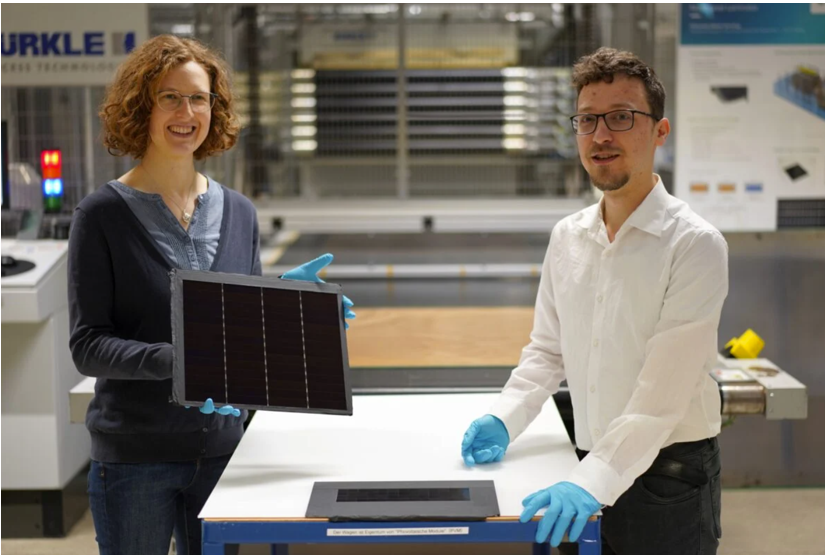
Recently, researchers at the Fraunhofer Institute for Solar Energy Systems (Fraunhofer ISE) in Germany announced two new efficiency records for tandem photovoltaic modules.
Both achievements are based on III-V semiconductor materials, derived from elements in groups III and V of the periodic table, which are known for their high conversion efficiency.
According to the researchers, one III-V germanium module achieved an efficiency of 34.2%, making it the world’s most efficient module.
This module, with an area of 833 cm², is part of Fraunhofer’s “Vorfahrt” project, which aims to develop cost-effective III-V solar cells. These cells are typically used in applications such as vehicles, aircraft, and space technology, where costs tend to be higher.
The module was constructed by the project coordinator, Azur Space Solar Power GmbH, using triple-junction III-V germanium cells optimized for the terrestrial solar spectrum. Project partner temicon GmbH further enhanced the module’s efficiency by applying a nanoimprint process to the glass surface, reducing reflection losses.
Fraunhofer ISE stated that the second record was achieved with a III-V silicon photovoltaic module, which reached an efficiency of 31.3%, setting a record in its category.
This module builds upon the 36.1% III-V silicon solar cell record achieved several years ago. As part of Fraunhofer’s “Mod30plus” research project, aimed at developing III-V/silicon modules with efficiencies of at least 30%, scientists produced these solar cells on a small scale and adapted them for interconnection using shingling technology. This ultimately led to the construction of the 218 cm² module with 31.3% efficiency.
Andreas Bett, Director of Fraunhofer ISE, commented: “Both tandem PV technologies have the potential to fill the application gap between conventional, cost-effective ground-mounted and rooftop systems and high-performance but more expensive space solar cells. III-V combined with silicon represents a more economical option, while III-V with germanium offers a slightly more efficient alternative. Both technological paths are attractive for integrated PV applications where space is limited.”
Traditional silicon solar cells have a theoretical maximum efficiency of 29.4%, while commercially available modules currently achieve efficiencies of around 24%.