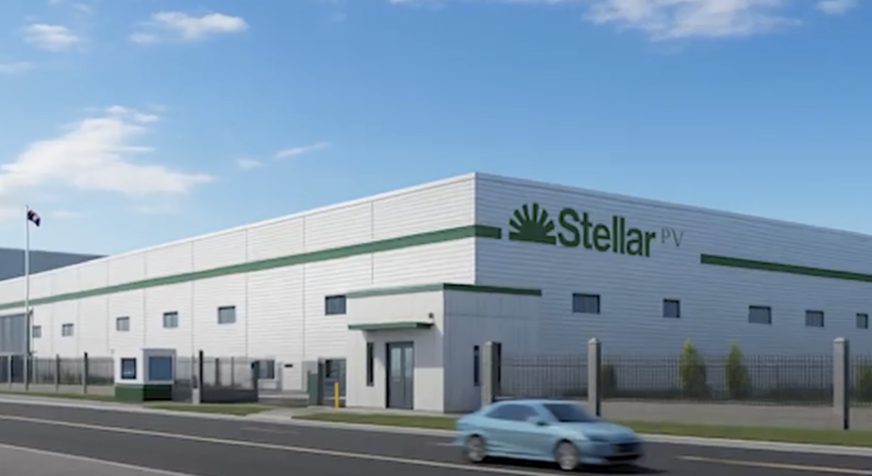
Sydney-based photovoltaic company Stellar PV’s planned 2GW polysilicon ingot and silicon wafer manufacturing facility in Queensland, Australia, has recently been officially granted “Major Project Status” by the Australian Government. This designation means the project will enter an expedited approval process, accelerating its subsequent implementation, with the company also confirming its target to begin production by the end of 2028.
As a photovoltaic enterprise headquartered in Sydney, Stellar PV’s chosen location near Townsville is central to building a low-carbon production base. Its primary operations will involve processing polysilicon into ingots, which are then further processed into photovoltaic silicon wafers. The total investment for this project is approximately A$400 million (equivalent to US$281 million), representing a key component of Australia’s strategy to establish a global photovoltaic manufacturing hub.
Regarding the acquisition of Major Project Status, Stellar PV stated that this recognition not only acknowledges the project’s national strategic significance but will also provide substantial support for its implementation. In accordance with relevant regulations, the project will directly receive specialized assistance from the Australian Government’s Major Projects Facilitation Agency. This will focus on resolving approval challenges in areas such as environmental protection, biosecurity, and foreign investment review, thereby significantly shortening the approval timeline.
Company CEO Louise Hurll emphasized the profound importance of this development for Australia’s photovoltaic industry. She stated that it will drive the transition from simply exporting critical raw materials to upgrading towards high-value-added photovoltaic manufacturing. This, in turn, can provide a stable, high-quality alternative supply chain for the global photovoltaic wafer market, potentially reshaping the existing supply landscape.
The project’s successful attainment of Major Project Status is also underpinned by solid pre-feasibility studies. Just recently, the project’s released interim pre-feasibility study report confirmed that establishing Australia’s first large-scale ingot pulling and silicon wafer factory is technically and commercially viable. Furthermore, it identified no substantive obstacles related to environmental, regulatory, or site selection issues, allowing for progression to the next stage of research. This pre-feasibility study was supported by the Australian Renewable Energy Agency (ARENA) and falls under the federal government’s A$1 billion “Solar Sunshot” program. The report indicated that preliminary assessments of the project’s process design, equipment selection, site requirements, and ESG commitments have been completed, providing a basis for commencing detailed engineering design. Concurrently, the continuously expanding battery and module production capacity in Europe and the Americas creates an urgent demand for wafer supply, offering strong market support for the project.
The report further pointed out that Australia’s advantages—including low-cost renewable energy, stable trade status, and a favorable policy environment—position the project to naturally meet global wafer demand. With production subsidies and capital expenditure support, the project is expected to achieve globally competitive pricing. This would not only create numerous high-value-added regional jobs and strengthen local industry self-sufficiency but also effectively alleviate a critical bottleneck in the global clean energy supply chain.
Based on these conclusive feasibility findings, Stellar PV has now initiated the next phase of the project, focusing on advancing detailed feasibility studies, front-end engineering design (FEED), and the preparation and submission of project development applications. According to the plan, provided all regulatory approvals proceed smoothly, the factory is scheduled to officially commence production by the end of 2028, at which point it will fill the void in large-scale photovoltaic silicon rod and silicon wafer manufacturing in Australia.