Ground-mounted power plants are entering the ultra-high-power string inverter era. The leap in single-unit power capacity has enabled the system to successfully implement “structural subtraction”: fewer devices, shorter cabling, and a more streamlined system architecture.
Traditionally, high power and high precision have been difficult to achieve simultaneously. However, from a practical application perspective, a leap in power levels should be accompanied by a corresponding leap in management density. If the per-unit power output is doubled while the number of internal MPPT channels is reduced accordingly, this essentially represents a regression in the system architecture rather than an evolution.
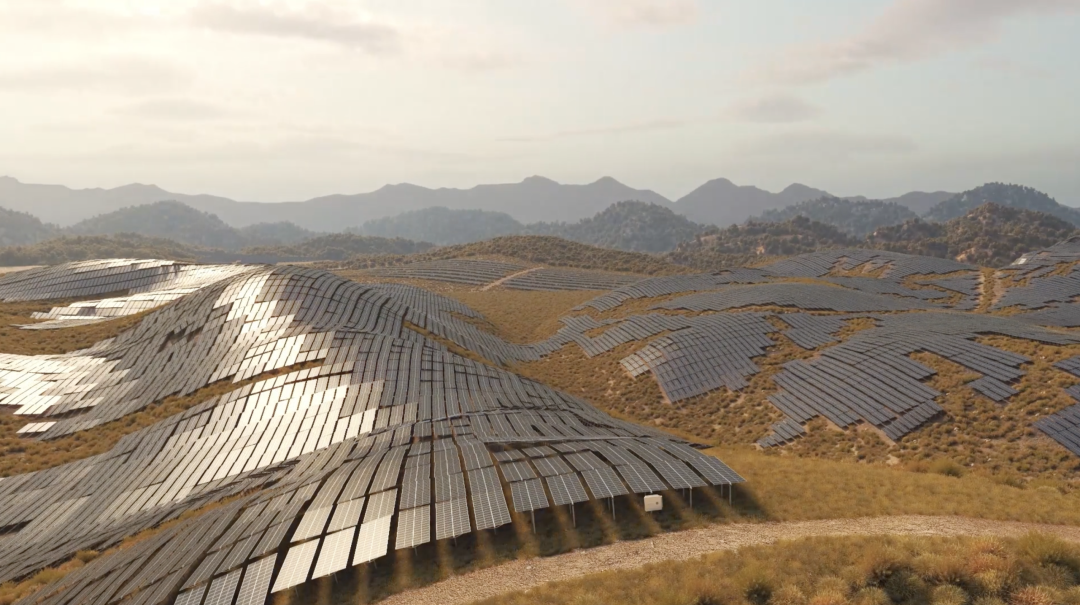
Therefore, the Sungrow 506kW ground-mounted inverter continues to feature a “true string” design. The so-called “true string” architecture goes beyond merely adopting a string-inverter topology. On a high-power platform, it maintains exceptionally fine MPPT control accuracy, enabling independent and precise management of every segment.
“Fine-grained management helps increase annual power generation by 2%”
MPPT (Maximum Power Point Tracking) is the core control unit of a PV inverter, and its configuration density directly affects the power plant’s generation efficiency and operational performance.
In traditional centralized systems, a single MPPT channel typically connects to 20 or more string circuits. Based on an estimate of approximately 30 modules per string, this equates to a single MPPT channel needing to manage more than 600 modules simultaneously. A single anomaly often has far-reaching repercussions, and localized losses can easily be amplified. In mainstream string-inverter systems, one MPPT channel typically connects 4 to 5 string circuits, corresponding to approximately 120 to 150 PV modules. Compared with centralized approaches, accuracy has already improved significantly. However, in large-scale installations, complex terrains, and multi-orientation scenarios, losses resulting from “averaged management” remain unavoidable.
However, in some high-power string-inverter solutions, although the single-inverter capacity has already exceeded 400 kW, the number of MPPT channels is often only around six. This means that a single MPPT channel still needs to accommodate more than 200 modules. As the system’s power output increases, the management scope expands accordingly.
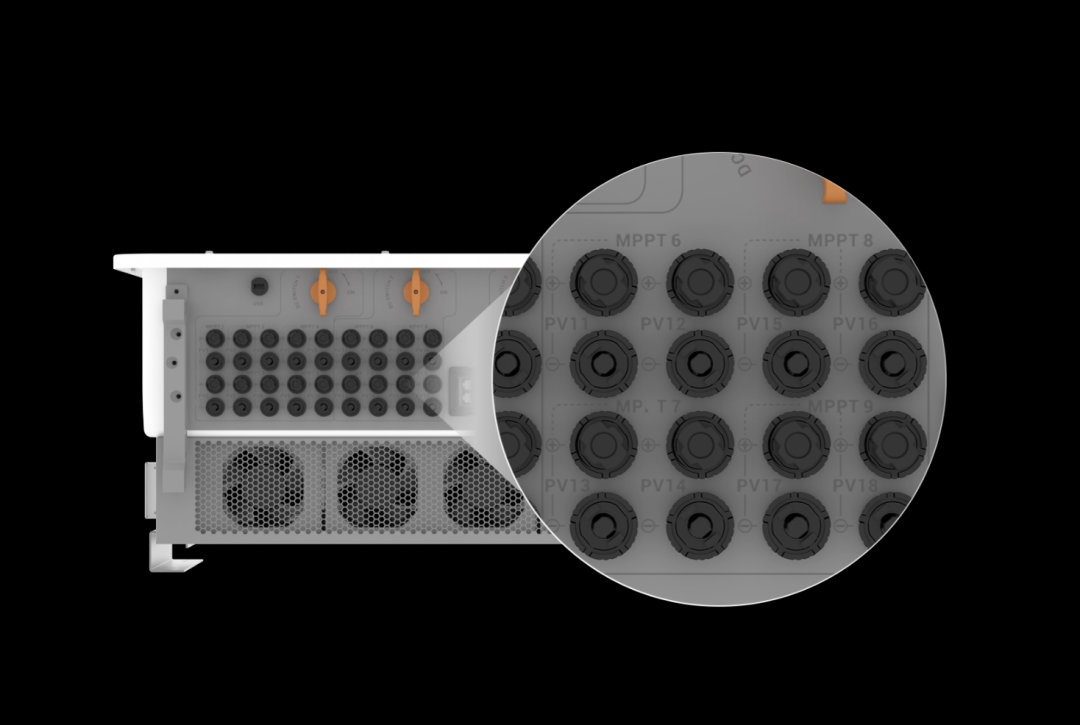
sige 506kW inverter adopts 18 MPPT design and adheres to the” 2 strings and 1 channel “true string configuration mode. each MPPT only manage about 60 components, which has higher optimization efficiency in complex scenarios and can significantly reduce the negative impact of string mismatch. The calculations show that, compared with a conventional, less optimized design, this configuration can increase the power output of the system by approximately 1.5% to 2%. For large-scale power plants, this is by no means a small figure; rather, it represents a substantial increase in revenue over the entire project lifecycle.
“Millisecond-level response, capturing every fleeting ray of sunlight”
Robust hardware is only the foundation; to truly unlock the value of 18 MPPT channels, agile software algorithms are essential. In practical operation, lighting conditions are constantly changing. For a PV inverter, the maximum power point is not a fixed value; rather, it continuously shifts.
This means that the effectiveness of MPPT lies not only in whether it can locate the maximum power point, but also in whether it can do so promptly and accurately. SG has optimized this process by developing its own MPPT algorithm.
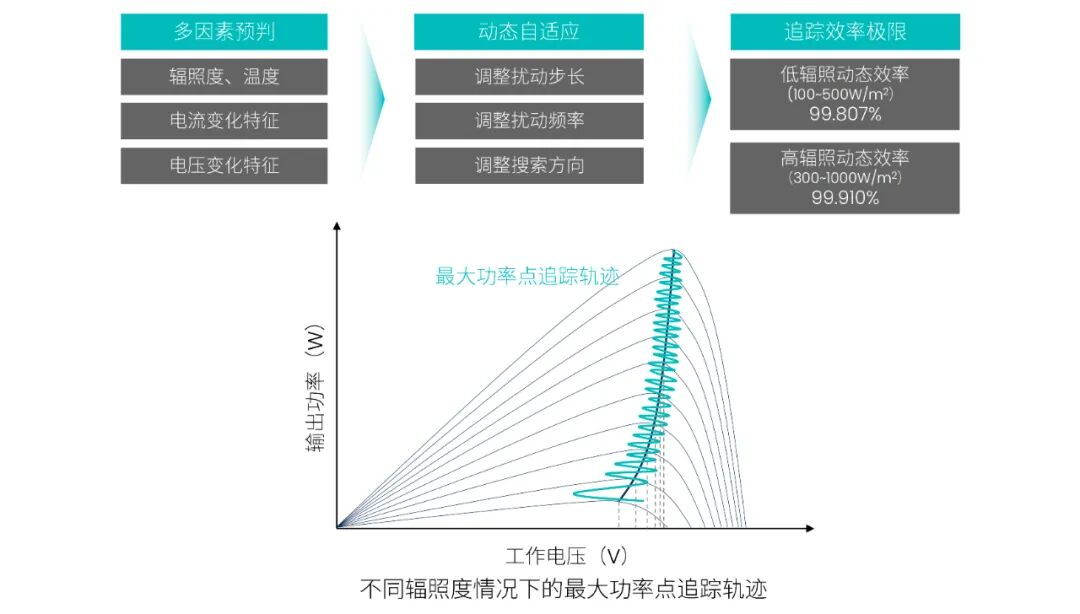
When faced with rapid fluctuations in light intensity, the SIG algorithm is faster and more accurate.
Conventional approaches typically rely on a fixed “sample–compute–execute” workflow. Under conditions of rapidly changing illumination, control responses tend to lag, causing the system to temporarily operate at suboptimal points. SG has optimized this process by developing its own MPPT algorithm. Leveraging multi-factor prediction and a dynamic adaptive mechanism, the system can complete decision-making and adjustments within milliseconds. Even under complex operating conditions, it rapidly converges to the optimal operating point, thereby minimizing power generation losses caused by transient solar irradiance fluctuations.
When faced with multi-peak curves, SIG can quickly identify the true maximum point.
Complex operating conditions such as partial occlusion and dust accumulation can cause multiple peaks to appear on the power curve. Conventional MPPT algorithms tend to get trapped at a local maximum power point, failing to identify the true global optimum, which results in power generation losses.
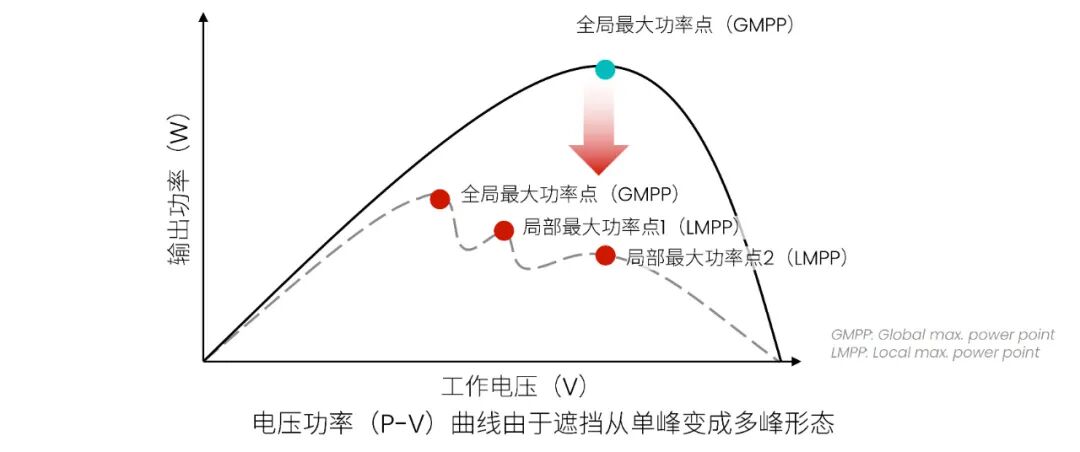
SG has adopted an innovative multi-peak MPPT scanning and optimization algorithm that can rapidly scan the entire power curve and accurately identify the true global maximum power point. Even in complex, occluded scenes, the system can reacquire the optimal operating point within approximately 10 seconds, whereas conventional approaches typically require 40 seconds or even a full minute to complete a single scan. Under continuously changing lighting conditions, this faster response time enables the system to return to high-efficiency operation more quickly, thereby maximizing the retention of energy that would otherwise be lost. This combination of software and hardware capabilities ensures that Sungrow’s string inverters can approach the theoretical maximum power output even under complex lighting conditions, allowing every ray of sunlight to be harnessed efficiently.
“18 MPPTs Build a Secure ‘Firewall’”
In utility-scale solar power plants, alongside generation efficiency, safety is an equally critical bottom line. As system scale continues to grow, with higher DC-side voltages and a greater number of string inverters, any localized abnormality can quickly escalate. Therefore, security capabilities are no longer simply a matter of “having protection” or not; they now hinge on the ability to detect threats earlier, pinpoint their source more quickly, and respond with greater precision. The foundation of Sungrow’s safety architecture is a “true string” design featuring 18 MPPTs, with two strings per MPPT. This not only enhances power generation efficiency but also confines potential risks to a smaller scope.
In traditional systems, a single fault signal may be associated with multiple string circuits and a large number of cables, resulting in lengthy troubleshooting procedures and extended downtime. Identifying faulty string circuits in gigawatt-scale power plants is often like looking for a needle in a haystack. Under Sungrow’s architecture, the control unit is configured for every two string circuits. Once an alarm is triggered in the monitoring system, the scope of the issue can be quickly narrowed down. Compared with traditional approaches, fault localization efficiency can be improved by approximately 15 times, significantly reducing troubleshooting and downtime. This shifts operations from “broad‑area searching” to “precise pinpointing.” For large-scale ground-mounted power plants, true reliability in safety management does not lie in addressing issues after they arise; rather, it involves making such issues less likely to escalate and easier to resolve swiftly.
“in the process of power transition, keep the bottom line of refinement”
from the hardware architecture of 18 MPPT, 2 strings and 1 channel, to the algorithm capability of millisecond response and multi-peak scanning, and to the fault detection on the DC side, the 506kW ground inverter wants to answer the same question: when the scale of the power station is getting larger and larger, can the string inverter continue to maintain its core value?
The answer is yes. A high-power platform does not inherently imply rough-and-ready management. Truly advanced high-power string inverters should, while scaling up system capacity, refine power-generation control, enhance fault-diagnosis accuracy, and rigorously maintain safety margins.