Anza, a market research organization, Renewables released the latest report “Pricing, Foreign Entities of Concern (FEOC) and Local Content Report for the First Quarter of 2026” (Q1 2026 Pricing, FEOC, & Domestic Content Report)-Affected by the surge in domestic manufacturing demand in the United States and the TOPCon technology patent infringement disputes, the price of single crystal PERC components in the United States soared 20% to 0.33 USD/W between November 2025 and February 2026, for the first time in history, the price of mainstream TOPCon modules was exceeded during the non-“safe harbor” drive period, while the overall median price of photovoltaic modules in the United States held steady at $0.285/W, while the price of energy storage systems continued to fall due to overcapacity.
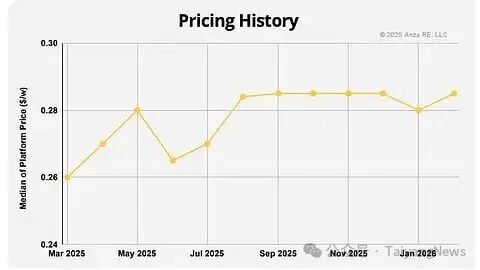
The report shows that US solar module prices remained generally stable in the first quarter of 2026, but policy uncertainty and the trend of shifting to local supply chains are reshaping market dynamics. The report shows that between November 2025 and February 2026, the median component price remained at $0.285/W, up 9.6 percent from $0.26/W in March last year, while the price of imported components remained flat at $0.265/W.
it is worth noting that the price of single crystal PERC components rose by 20% to us $0.33/W during the same period. this is the first time that PERC price has exceeded TOPCon, the main technology in the industry, since the rush triggered by the “investment tax credit” (ITC) safe harbor clause last year, resulting in a recovery in demand for this technology compared with the current main technology in the industry. In contrast, the price of TOPCon components remained stable at about US $0.28/W. The price of heterojunction (HJT) components fell slightly by 2% to remain at about US $0.38/W.
Anza pointed out that its tracking data covering more than 95% of the supply of solar modules in the United States showed that the price of batteries produced in the United States rose by 8.2 to 0.49 US dollars/W, while the price of modules assembled in the United States using international batteries rose by 4.9 to 0.325 US dollars/W. According to Anza, the sharp rise in the price of PERC components is mainly due to buyers locking in supply before the ITC safe harbor deadline of July 3, 2026, thus pushing up the strong demand for locally made components.
In addition, the patent infringement disputes surrounding TOPCon technology and the “337 investigation” initiated by the U.S. International Trade Commission (USITC) are also key factors in driving buyers to move to single crystal PERC technology. At the same time, increased market demand for components that meet “foreign entities of concern” (FEOC) compliance requirements has further contributed to the price increase. Analysts believe that policy moves are beginning to affect pricing more directly, and the upcoming polysilicon “232 investigation” ruling and ongoing “337 cases” may further disrupt the market.
Unlike the photovoltaic module market, the price of energy storage systems continues to fall, especially for ground power station projects. Anza attributed this to the normalization of raw material costs, overcapacity in the market and ongoing supply chain dynamics. Data show that the median price of a utility-scale AC side packaging system (AC Wrap) with a capacity of 200MW/4 hours fell 8.6 percent to $177/kWh. The price of self-integrated systems fell 5.8 percent to $145/kWh. For a 10MW/4-hour distributed generation (DG) scale AC packaged system, the price fell by 3.4 to $203/kWh, but the price of a self-integrated system of the same specification rose slightly by 1.1 to $175/kWh.
Anza analysts explained: “The price stabilization and slight upward trend in this segment appears to be driven by a shift in supplier focus to support large independent power producers (IPP) and data center projects.” They added, “As manufacturers increasingly prioritize these gigawatt-hour-scale mega-deployments, the distributed generation segment is likely to be seen as a secondary mission by many providers. This shift in priority could lead to tighter supply of configurations suitable for distributed generation, which could lead to price stabilization.”
Looking ahead, Anza listed policy risks to focus on, including “337 investigations”, anti-dumping/countervailing duties (AD/CVD) against India/Indonesia/Laos, polysilicon “232 investigations” and “301 investigations” involving overcapacity and forced labor “. The report also mentions a “continuing upward” trend in detention incidents in the first quarter of 2026. Recently, South Korea’s Qcells’ Georgia plant has been allowed to release shipments and resume normal solar module production after being detained by U.S. Customs and Border Protection (CBP) for several months on suspicion of using banned components from China.