It used to be cheaper than whose batteries are now bigger, more durable and safer than whose batteries. This “big guy” race is determining the future of the energy storage industry.
A few days ago, Beijing held a conference on the energy storage industry (ESIE 2026 Energy Storage Exhibition), just like the Spring Festival Gala of the energy storage industry “. If you go around the exhibition hall, you will find a particularly obvious change: in the past, companies were drying a variety of “big cabinets” (energy storage systems). This year, everyone coincidentally put their largest “battery blocks” (batteries) in the most conspicuous position.
587, 628, 790, 1175… These figures are not prices, but the unit of capacity of the cell, “Amp-hour” (Ah). The larger the number, the stronger the “capacity” and energy storage capacity of a single battery block.
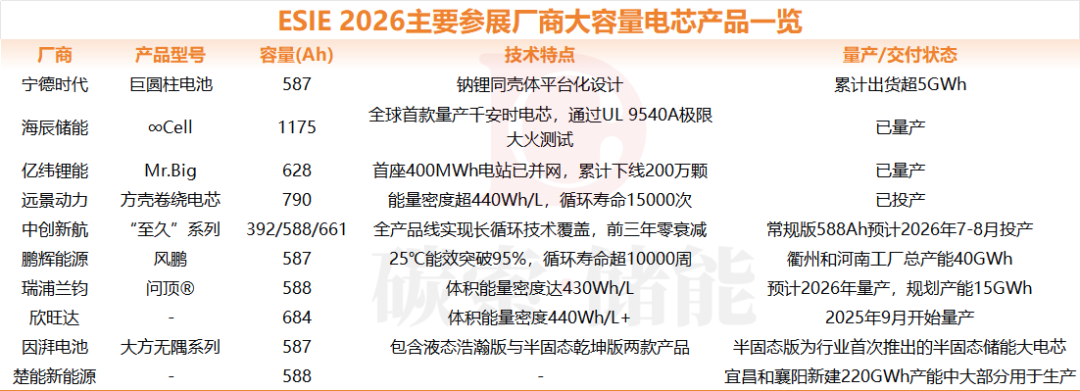
Drawing: Carbon cable energy storage. Or there are omissions, for reference only.
An exhibitor said: “In the past, when customers came, they asked how much electricity was once, the cheaper the better. Now customers will ask, how much is the average cost in 10 years? Will it be bad? Can it be perfectly matched with our wind farms and data centers? “
This simple sentence tells the changing of the industry: from the barbaric growth of” cheaper than others “, it has entered a new stage of” better value and better use than others. The main battlefield of this competition is these “big” batteries.
At the beginning of this year, the National Development and Reform Commission and the National Energy Administration jointly issued the “Notice on Improving the Power Generation Side Capacity Electricity Price Mechanism” (Development and Reform Price [2026] No. 114), which is a blockbuster new policy that determines the future direction of energy storage.
In the past, energy storage power stations made money mainly by electricity price difference (charging when low price, discharging when high price), like “stock speculation”, unstable. The new policy is equivalent to giving energy storage a “guaranteed wage”. As long as it is built in the place where the power grid needs and has the ability to adjust, it can get a stable income. Under this circumstance, everyone is more motivated to build energy storage, and they are more willing to pay for high-quality, long-life products.
At the same time, another huge demand broke out:
The power center (also called the data center) needed to AI large model training is extremely power consumption, and the power demand fluctuates like a roller coaster. This puts a huge strain on the grid. As a result, a new huge market has been opened-with large capacity of energy storage, to these “AI stomach king” when the “regulator” and “charging treasure”, to ensure their 24-hour stable operation.
The policy brings “big customers” to the “basic salary” and AI. Energy storage has suddenly changed from a “running younger brother” of new energy to a “key gentleman” to ensure the safety of future power and computing power “. To be good at this role, you have to have a strong product. Therefore, the focus of industry competition naturally shifted from “price” to “value”. The “big” battery core is the core weapon to achieve “high value.
the most obvious feeling of this year’s exhibition is that the 587Ah giant cylindrical battery of
, which was bragged on PPT and exhibition board last year, has sold more than 5GWh (equivalent to the daily electricity consumption of 500000 households); 628Ah large battery, two million units have already stepped off the production line, and the first 400 megawatt-hour power station with this battery has been connected to the grid for power generation. Even launched 1175Ah “Big Mac”, is the industry’s first mass production of four-digit capacity batteries; Other companies have also shown their products above 500Ah and given a clear schedule for mass production: “Production in July and August this year”, “planning capacity 40GWh”, “energy production this year”…
one sentence summary:
According to incomplete statistics, the three days of the exhibition, the total scale of orders and cooperation agreements signed by various enterprises exceeded 127GWh, most of which were carried out around these large batteries. The industry is moving from the stage of “I can do” to the stage of “I can sell and deliver.
the most direct advantage of making the battery cell bigger is to imagine that the capacity that used to be achieved by installing 10000 small batteries is now 2,000 large batteries. the number of batteries is less, the connection line, management system, installation and maintenance are simpler, and the overall cost is naturally reduced.
But “big” also brings new problems:
Like a gas tank, the bigger the tank, the more serious the consequences may be. Therefore, at this year’s exhibition, companies are more than “big” and are desperately trying to prove their products.
“acupuncture experiment” has become the standard publicity-use a steel needle to pierce a fully charged battery to see if it will catch fire and explode. Some companies even did a more extreme “thousand-degree fire” test, putting the entire battery pack in a fire to demonstrate its excellent heat insulation and fire resistance.
In addition to the safety of materials and structures, the technical route has also begun to “separate”:
began to join the battlefield. Electrolyte is like jelly, which is safer than traditional liquid and is not flammable.
also to “grab the site”, although the energy density is temporarily not as good as lithium batteries, but its raw materials are cheaper, more resistant to low temperatures, in some cost-sensitive or extremely cold scenes have an advantage.
Therefore, the current “large-capacity” competition has been upgraded to a comprehensive all-round competition.
The AI computing center mentioned earlier has become the hottest “star customer” of this exhibition “. Almost every energy storage company has designed a product solution specifically for it, and the industry calls it AIDC.
Why do AI eat so much?
A large AI data center uses as much electricity as a small city.
Power cannot be cut off, and the voltage and current must be extremely stable, otherwise the computing power training worth hundreds of millions of dollars may be interrupted and all previous efforts will be wasted.
Its workload suddenly rises and falls, which is a huge impact on the power grid.
Energy storage is the “specific medicine” to solve these pain points “. There are various schemes at the exhibition:
there are super fast rechargeable batteries that can realize “10 times speed” discharge to cope with instant power failure; There is an integrated scheme of “photovoltaic energy storage” to help data centers use cheap green electricity. There is a scheme that combines new transformers to ensure power quality.
The industry predicts that by 2030, this is a new and huge high-end market. Whoever can create the most stable and smartest energy storage system for AI customers on the basis of “big” batteries can seize the biggest growth opportunity in the next decade.
Now the top ten global energy storage battery shipments are all Chinese companies. It can be said that in the “manufacturing” link, Chinese companies have dominated the world.
But far from over, the competition has entered a more difficult stage:
During the exhibition, three companies announced that they had won major overseas orders in one day. This shows that China’s energy storage enterprises are upgrading from “product export”. This is not only to sell batteries abroad, but also to build a local team, do services, and meet various standards and policies.
this spell is not a simple manufacturing capacity, but:
can the product be delivered to any corner of the world on time, with good quality and quantity? Can you help customers solve financial problems? Can you respond quickly to problems?
Therefore, the future winners must be “all-round players” who can build good batteries, play with the global market and deeply understand the needs of different customers “.
In the heat, we should also calmly see several problems:
Your family does 587, my family does 628, and his family does 790… Although they are all “big guys”, their sizes and capacities are different. This will cause trouble for downstream companies that do energy storage systems, which is not easy to standardize and may push up costs.
The new capacity planned by everyone adds up to an astronomical figure. In the next two or three years, when all these capacities are released, will the market be able to eat it? Will there be another fierce price war?
Many companies advertise that the batteries can be used for 15 years and cycle tens of thousands of times. But it takes time to verify in actual use. The perfect performance in the laboratory does not mean that it can be as reliable in the wild for more than ten years.
To sum up, the explosion of large-capacity batteries is the result of the joint promotion of the three.
In the future, the next generation of technologies such as sodium batteries and all-solid-state batteries will gradually mature and bring new possibilities; who can become a global energy storage brand, who can win a greater future; in the end, All competitions will return to a simple question, does your energy storage system create the greatest value for customers in the entire life cycle? Is it safer, cheaper and more intimate?
The battlefield of “big” batteries is no longer in the word “big. It’s just a ticket. The real race is a whole set of solutions built around it to make energy safer, cheaper and smarter.
Who can do this “comprehensive problem”, who can laugh at the last.