on April 2, 2026, during the 14th Beijing international energy storage summit and exhibition (ESIE 2026), Mr. ouyang Chao, general manager of soying electric energy storage division, was invited to participate in the interview session of “zhihui Zhongguancun energy storage tycoon”. with profound industry accumulation and rich practical experience, he had in-depth dialogue with colleagues in the industry and shared soying electric’s layout thinking and technical achievements in the energy storage field, as well as unique insights into the future development of the industry.
the following is the live video and text arrangement of this interview, taking you to directly hit the big coffee to share the scene
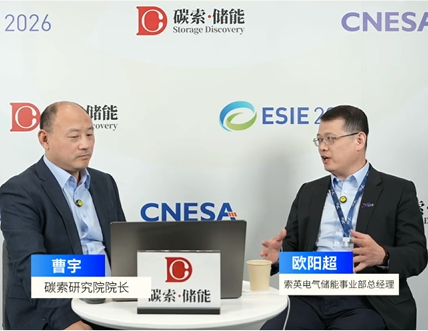
Q1: when you first entered the energy storage link, what was the current situation of the industry? When did Soying start working in the field of energy storage?
A: Before 2020, in fact, most of them are still from the perspective of demonstration projects. Soying has done many demonstration projects. Soying started from the microgrid, did the national grid related projects, plus some rooftop photovoltaic systems, formed a microgrid system. PCS was also first developed by Soying in China. It was in 2009 and has been 17 years since now.
Q2: After several cycles of the energy storage industry, which one impressed you more?
Answer: From my personal point of view, energy storage has not actually experienced the so-called ups and downs of the cycle, it has been rising. As the earliest practitioners, we have been seeking technical verification and engineering practice in these demonstration projects. Looking back, these processes are very valuable.
Q3: Now everyone also says that the industry is starting to roll in, a bit like photovoltaic. Photovoltaic installed capacity has been growing for 20 years, but it has also experienced several rounds of reshuffle. We have previously counted that the industry mortality rate is as high as 97%. Although there is no large-scale reshuffle in the energy storage industry, the pattern has slowly begun to change. What is your opinion on this?
A: In the early stage, the issue of power restriction was more talked about in the industry. Both wind power and photovoltaic could not be well utilized. By 2017 and 2018, it was proposed to control the power restriction ratio at about 5%, which promoted the energy storage allocation. It required the wind and solar power stations to be equipped with 5% and 10% energy storage to solve some of the power restriction problems. Gradually, a mode of configuring each wind and solar power station with a two-hour energy storage system in proportion was formed, which is what everyone calls strong allocation. The current independent energy storage, relying on the actual operation of the energy storage system to generate revenue, will put forward higher requirements for equipment and operations than before, which also promotes the industry to gradually develop in a healthy direction.
Q4: What new products did Soying bring to this exhibition?
A: Energy storage essentially solves the problem of power balance. When we study electricity, we all know that electricity cannot be stored on a large scale. We pay attention to the real-time balance between distribution and use. The scheduling function is very critical. From the perspective of power system, long-term power balance can be solved by pumped storage, but the power problem, especially the transient problem, is most suitable for electrochemical energy storage to play its advantages, its biggest feature is fast and accurate.
In response to these needs, Soying has launched a network-based product. The reason why grid-type products are valued and praised is that the current new power system presents the characteristics of “double high”-high power electronics, high proportion of renewable energy, and the control logic and composition structure of the power system have undergone tremendous changes., From the original thermal power-based shift to new energy-based. This will lead to a reduction in the inertia of the power grid, an increase in voltage and frequency instability, and problems such as broadband oscillations may also occur, and the power grid urgently needs to enhance the inertia, voltage, and frequency support capabilities.
At present, there is no unified definition of network type in the academic community, but the industry consensus is that it can actively support the voltage and frequency of the power grid, and has rich functions such as grid-connected, off-grid, and grid-connected operation. The realization of these functions requires profound engineering practical experience and technical accumulation.
Q5: Relying on our network-based technology, we can build city-level power grids out of thin air to support the construction of gigawatt-level power stations not only in deserts, western regions and other regions, but also in countries along the “the belt and road initiative” such as Asia, Africa and Latin America. At the same time, advanced manufacturing is becoming more and more intelligent. We can build black light factories overseas with the help of network technology to quickly help the local industrialization and modernization. As a senior practitioner in the industry, how do you view the development of network construction technology? What are the technical advantages of Suoying in this field?
Answer: “network construction” is not a new concept in fact, it has been proposed as early as the 1980 s, and it has been applied in the earliest microgrid scenario. The parallel connection of power electronic equipment in the off-grid state is the technical pearl in the field of network construction, and it is also the most difficult part to overcome.
Power electronic equipment itself does not have rotor inertia, can only rely on virtual inertia, weak support for frequency, but also have good overload, high and low voltage transient suppression ability, in order to achieve stable operation.
Soying has been working in this field for a long time, has a solid technical foundation, can cope with complex network operation scenarios, and ensure the stability and reliability of the system.
Q6: At present, Soying has delivered more than 16 GW of energy storage systems and served more than 300 projects. Can you share some of the most representative classic projects?
a: we have recently landed a number of GWh power stations, two in Xinjiang last year: one is Xinjiang huadian 1GW/4GWh power station, and the other is CNNC 500MW/2GWh power station, of which CNNC project is the first GWh power station in Xinjiang to be transferred to commercial operation. In the network test of the project, Soying equipment showed excellent performance and the network operation was stable and reliable. Especially in the short-circuit experiment, none of the equipment went off the grid, providing strong support for the power grid.
Q7: soying has formed a number of core capabilities in PCS, cluster control, system integration and power station operation and maintenance. can you share them in detail?
a: soying’s main business is PCS electrical system, and it also lays out battery testing business. We have always believed that good energy storage must grasp two points: first, to understand the power grid, energy storage is different from photovoltaic, wind power, the core is to solve the voltage, frequency support and inertia problems, we must deeply understand the power grid demand, in order to make the energy storage system better adapt to the power grid. The second is to understand the battery, familiar with the battery operating characteristics. At present, in the process of the construction of the new power system, the power supply structure and load pattern have undergone great changes. Electric vehicle overcharging and flash charging bring high-power load impact. Coupled with the access of energy storage, it is necessary to further study the new power grid control theory and think about the integration path of system construction and energy storage from a higher dimension.